Advertisements
Advertisements
प्रश्न
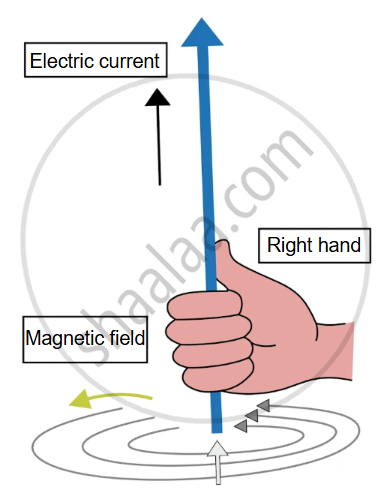
Write the two names in the following diagram.
Right hand thumb rule.
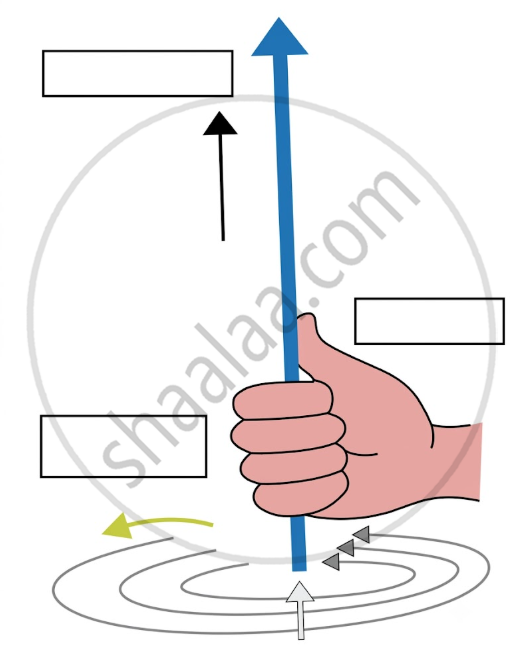
Label the following diagram.
Right-hand thumb rule.
Advertisements
उत्तर
APPEARS IN
संबंधित प्रश्न
The magnetic flux through a loop varies according to the relation Φ = 8t2 + 6t + C, where ‘C’ is constant, 'Φ' is in milliweber and 't' is in second. What is the magnitude of induced e.m.f. in the loop at t = 2 seconds.
A solenoid of length 1.5 m and 4 cm in diameter possesses 10 turns per metre. A current of 5 A is flowing through it. The magnetic induction at a point inside the solenoid along the axis is ............................. .
(μ0 = 4π × 10-7 Wb/Am)
- π × 10-5 T
- 2π × 10-5 T
- 3π × 10-5 T
- 4π × 10-5 T
State Fleming’s right-hand rule.
State three differences between direct current and alternating current.
A horizontal straight wire 10 m long extending from east to west is falling with a speed of 5.0 m s−1, at right angles to the horizontal component of the earth’s magnetic field, 0.30 × 10⁻⁴ Wb m−2.
- What is the instantaneous value of the emf induced in the wire?
- What is the direction of the emf?
- Which end of the wire is at the higher electrical potential?
If ‘R’ is the radius of dees and ‘B’ be the magnetic field of induction in which positive charges (q) of mass (m) escape from the cyclotron, then its maximum speed (vmax) is _______.
A) `(qR)/(Bm)`
B)`(qm)/(Br)`
C) `(qBR)/m`
D) `m/(qBR)`
When a wire is moved up and down in a magnetic field, a current is induced in the wire. What is this phenomenon known as?
When Puja, a student of 10th class, watched her mother washing clothes in the open, she observed coloured soap bubbles and was curious to know why the soap bubbles appear coloured. In the evening when her father, an engineer by profession, came home, she asked him this question. Her father explained to her the basic phenomenon of physics due to which the soap bubbles appear coloured.
(a) What according to you are the values displayed by Puja and her father?
(b) State the phenomenon of light involved in the formation of coloured soap bubbles.
Can a transformer work when it is connected to a D.C. source? Give a reason.
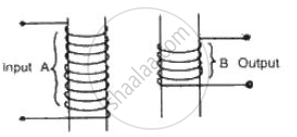
Complete the following diagram of a transformer and name the parts labeled A and B. Name the part you have drawn to complete the diagram . What is the material of this part? In this transformer a step-up or step-down? Why?
The right-hand thumb rule is also called _______ rule.
An induced current of 2.5 mA flows through a single conductor of resistance 100 Ω. Find out the rate at which the magnetic flux is cut by the conductor.
A coil of 200 turns carries a current of 4 A. If the magnetic flux through the coil is 6 x 10⁻⁵ Wb, find the magnetic energy stored in the medium surrounding the coil.
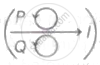
Metal rings P and Q are lying in the same plane, where current I is increasing steadily. The induced current in metal rings is shown correctly in figure.
A cylindrical bar magnet is kept along the axis of a circular coil. If the magnet is rotated about its axis, then ____________.
A generator has an e.m.f. of 440 Volt and internal resistance of 4000 hm. Its terminals are connected to a load of 4000 ohm. The voltage across the load is ______.
There is a uniform magnetic field directed perpendicular and into the plane of the paper. An irregular shaped conducting loop is slowly changing into a circular loop in the plane of the paper. Then ______.
A metal plate can be heated by ______.
Sea turtles return to their birth beach many decades after they were born due to ______.
A 0.4 m wire, stretched horizontally, carries an electric current of 15 A, in a magnetic field whose magnetic field intensity is 0.1 N/Am. What is the magnitude of the wire?
Which of the following phenomena makes use of electromagnetic induction?
A rectangular, a square, a circular and an elliptical loop, all in the (x - y) plane, are moving out of a uniform magnetic field with a constant velocity `vecv = vhati`. The magnetic field is directed along the negative z-axis direction. The induced emf, during the passage of these loops, out of the field region, will not remain constant for ______.
The primary of a transformer has 400 turns while the secondary has 2000 turns. If the power output from the secondary at 1000 Vis 12 kW, what is the primary voltage?
Show that for a given positive ion species in a cyclotron, (i) the radius of their circular path inside a dee is directly proportional to their speed, and (ii) the maximum ion energy achievable is directly proportional to the square of the magnetic induction.
A sheet is placed on horizontal surface in front of a strong magnetic pole. A force is needed to:
- hold the sheet there if it is magnetic.
- hold the sheet there if it is non-magnetic.
- move the sheet away from the pole with uniform velocity if it is conducting.
- move the sheet away from the pole with uniform velocity if it is both, non-conducting and nonpolar.
Choose the correct statement(s) from the options given below:
What do moving electric charges produce?
What can produce a current in a coil even when the coil does not move?
Which movement of a coil can produce a current?
Which change in the current of a nearby solenoid coil can produce an induced current?
What is produced when a magnet moves towards or away from a coil?
Which movement can change the number of magnetic field lines passing through a coil near a solenoid?
What is a solenoid?
Which device used for using electricity developed from Faraday’s and Henry’s experiments?
