Advertisements
Advertisements
प्रश्न
Calculate the dimensions of (a) \[\int \overrightarrow{E} . d \overrightarrow{l,}\] (b) vBl and (c) \[\frac{d \Phi_B}{dt}.\] The symbols have their usual meaning.
Advertisements
उत्तर
(a) The quantity \[\int \overrightarrow{E} . d \overrightarrow{l,}\] can also be written as :-
\[\int \overrightarrow{E} . d \overrightarrow{l,}=V......\text(V = Voltage)\]
Unit of voltage is J/C.
Voltage can be written as:-
`"Voltage"="Energy"/"Charge"`
Dimensions of energy = [ML2T-2]
Dimensions of charge = [IT]
Thus, the dimensions of voltage can be written as:
[ML2T-2] ×[IT]−1 = [ML2I−1T−3]
(b) The quantity vBl is the product of quantities v, B and L.
Dimensions of velocity v = [LT−1]
Dimensions of length l = [L]
The dimensions of magnetic field B can be found using the following formula:-
`B=F/(qv)`
Dimensions of force F = [MLT−2]
Dimensions of charge q = [IT]
Dimensions of velocity = [LT−1]
The dimensions of a magnetic field can be written as:
MI−1T−2
∴ Dimensions of vBl = [LT−1] × [MI−1T−2] × [L]= [ML2I−1T−3]
(c) The quantity \[\frac{d\phi}{dt}\] is equal to the emf induced; thus, its dimensions are the same as that of the voltage.
Voltage can be written as:-
`"Voltage"="Energy"/"Charge"`
Dimensions of energy = [ML2T-2]
Dimensions of charge = [IT]
The dimensions of voltage can be written as:
[ML2T-2] ×[IT]−1 = [ML2I−1T−3]
∴ Dimensions of \[\frac{d\phi}{dt}=ML^2I^{−1}T^{−3}\]
APPEARS IN
संबंधित प्रश्न
Explain why, an electromagnet is called a temporary magnet.
Explain why, the core of an electromagnet should be of soft iron and not of steel.
When current is 'switched on' and 'switched off' in a coil, a current is induced in another coil kept near it. What is this phenomenon known as?
What do you understand by the term "electromagnetic induction"? Explain with the help of a diagram.
Welders wear special goggles or face masks with glass windows to protect their eyes from electromagnetic radiations. Name the radiations and write the range of their frequency.
Draw a simple labeled diagram of a step-up transformer.
The following diagram shows a fixed coil of several turns connected to a center zero galvanometer G and a magnet NS which can move in the direction shown in the diagram.
- Describe the observation in the galvanometer if
- The magnet is moved rapidly,
- The magnet is kept still after it has moved into the coil
- The magnet is then rapidly pulled out the coil.
- How would the observation in (i) of part (a) change if a more powerful magnet is used?

What is an electromagnet?
List some of the practical applications of an electromagnet.
A thin semi-circular conducting ring (PQR) of radius r is falling with its plane vertical in a horizontal magnetic field B, as shown in the figure.
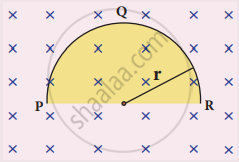
The potential difference developed across the ring when its speed v , is
State Fleming’s right-hand rule.
What for an inductor is used? Give some examples.
Give an illustration of determining direction of induced current by using Lenz’s law.
A 50 cm long solenoid has 400 turns per cm. The diameter of the solenoid is 0.04 m. Find the magnetic flux linked with each turn when it carries a current of 1 A.
A cylindrical bar magnet is kept along the axis of a circular coil. If the magnet is rotated about its axis, then ____________.
An expression for oscillating electric field in a plane electromagnetic wave is given as Ez = 300 sin(5π × 103x - 3π × 1011t)Vm-1 Then, the value of magnetic field amplitude will be ______. (Given: speed of light in Vacuum c = 3 × 10⁸ ms-1)
In the current carrying conductor (AOCDEFG) as shown, the magnetic induction at point O is ______.
(R1 and R2 are radii of CD and EF respectively. l = current in the loop, μ0 = permeability of free space)
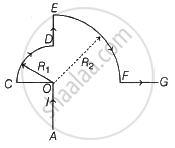
Which type of force is experienced by a moving charge in a magnetic field?
Which type of motor works on electromagnetic induction?
