Advertisements
Advertisements
प्रश्न
Consider the energy density in a solenoid at its centre and that near its ends. Which of the two is greater?
Advertisements
उत्तर
In a solenoid, energy is stored in the form of a magnetic field. If a constant current flows through the solenoid, the magnetic field inside is approximately uniform at the centre but decreases near the ends. The energy per unit volume (or energy density) in the magnetic field is given by `mu = B^2/(2mu_0)`.
Since B is stronger at the centre and weaker near the ends, the energy density is greater at the centre than near the ends.
APPEARS IN
संबंधित प्रश्न
State three differences between direct current and alternating current.
When a bar magnet is pushed towards (or away) from the coil connected to a galvanometer, the pointer in the galvanometer deflects. Identify the phenomenon causing this deflection and write the factors on which the amount and direction of the deflection depends. State the laws describing this phenomenon.
A horizontal straight wire 10 m long extending from east to west is falling with a speed of 5.0 m s−1, at right angles to the horizontal component of the earth’s magnetic field, 0.30 × 10⁻⁴ Wb m−2.
- What is the instantaneous value of the emf induced in the wire?
- What is the direction of the emf?
- Which end of the wire is at the higher electrical potential?
An emf of 2V is induced in a coil when the current in it is changed from 0A to 10A in 0·40 sec. Find the coefficient of self-inductance of the coil.
What is an electromagnet? Describe the construction and working of an electromagnet with the help of a labelled diagram.
When current is 'switched on' and 'switched off' in a coil, a current is induced in another coil kept near it. What is this phenomenon known as?
Electromagnetic induction means ______.
L, C and R represent the physical quantities inductance, capacitance and resistance respectively. Which of the following combinations have dimensions of frequency?
(a) `1/(RC)`
(b) `R/L`
(c) `1/sqrt(LC)`
(d) C/L
A conducting square loop having edges of length 2.0 cm is rotated through 180° about a diagonal in 0.20 s. A magnetic field B exists in the region which is perpendicular to the loop in its initial position. If the average induced emf during the rotation is 20 mV, find the magnitude of the magnetic field.
Figure shows a wire sliding on two parallel, conducting rails placed at a separation l. A magnetic field B exists in a direction perpendicular to the plane of the rails. What force is necessary to keep the wire moving at a constant velocity v?
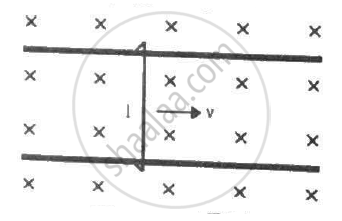
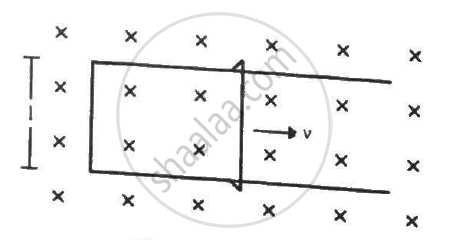
Figure shows a long U-shaped wire of width l placed in a perpendicular magnetic field B. A wire of length l is slid on the U-shaped wire with a constant velocity v towards right. The resistance of all the wires is r per unit length. At t = 0, the sliding wire is close to the left edge of the U-shaped wire. (a) Calculate the force needed to keep the sliding wire moving with a constant velocity v. (b) If the force needed just after t = 0 is F0, find the time at which the force needed will be F0/2.0
Draw and label the diagram of a simple D.C. motor.
(a) Explain the rotation of the coil, giving a reason for your answer.
(b) How can you reverse the direction of rotation of the armature?
(c) How can you increase the speed of rotation of the motor?
The right-hand thumb rule is also called _______ rule.
Find the odd one out and give its explanation.
Give an illustration of determining direction of induced current by using Lenz’s law.
A layer of atmosphere that reflects medium frequency radio waves which is ineffective during night, is ______.
Sea turtles return to their birth beach many decades after they were born due to ______.
What can produce a current in a coil even when the coil does not move?
What change can produce a current in a stationary conductor?
What is the current produced in a coil due to electromagnetic induction called?
