Advertisements
Advertisements
प्रश्न
State the condition at which we say the two coils kept close to each other are perfectly coupled with each other.
Advertisements
उत्तर
When the coefficient of coupling (K) is 1, then the two coils kept close to each other are said to be perfectly coupled with each other.
APPEARS IN
संबंधित प्रश्न
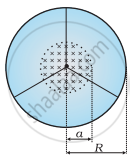
A line charge λ per unit length is lodged uniformly onto the rim of a wheel of mass M and radius R. The wheel has light non-conducting spokes and is free to rotate without friction about its axis (Figure). A uniform magnetic field extends over a circular region within the rim. It is given by,
B = − B0 k (r ≤ a; a < R)
= 0 (otherwise)
What is the angular velocity of the wheel after the field is suddenly switched off?
A circular coil of cross-sectional area 200 cm2 and 20 turns is rotated about the vertical diameter with angular speed of 50 rad s−1 in a uniform magnetic field of magnitude 3.0 × 10⁻²T. Calculate the maximum value of the current in the coil.
What is an electromagnet? Describe the construction and working of an electromagnet with the help of a labelled diagram.
The north-south polarities of an electromagnet can be found easily by using:
(a) Fleming's right-hand rule
(b) Fleming's left-hand rule
(c) Clock face rule
(d) Left-hand thumb rule
The most suitable material for making the core of an electromagnet is:
(a) soft iron
(b) brass
(c) aluminium
(d) steel
When current is 'switched on' and 'switched off' in a coil, a current is induced in another coil kept near it. What is this phenomenon known as?
An induced current is produced when a magnet is moved into a coil. The magnitude of induced current does not depend on:
(a) the speed with which the magnet is moved
(b) the number of turns of the coil
(c) the resistivity of the wire of the coil
(d) the strength of the magnet
- What kind of energy change takes place when a magnet is moved towards a coil having a galvanometer at its ends?
- Name the phenomenon.
In which of the following case does the electromagnetic induction occur?
A loop of wire is held near a magnet.
Name and state the law which determines the direction of induced current.
or
State Fleming’s right-hand rule.
Welders wear special glass goggles while working. Why? Explain.
The coil of a moving-coil galvanometer keeps on oscillating for a long time if it is deflected and released. If the ends of the coil are connected together, the oscillation stops at once. Explain.
Consider the energy density in a solenoid at its centre and that near its ends. Which of the two is greater?
A conducting rod is moved with a constant velocity v in a magnetic field. A potential difference appears across the two ends _____________ .
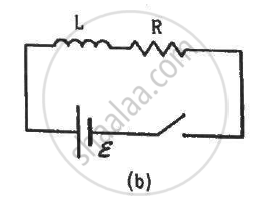
The switches in figure (a) and (b) are closed at t = 0 and reopened after a long time at t = t0.
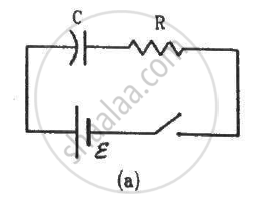
(a) The charge on C just after t = 0 is εC.
(b) The charge on C long after t = 0 is εC.
(c) The current in L just before t = t0 is ε/R.
(d) The current in L long after t = t0 is ε/R.
Draw a simple labeled diagram of a step-up transformer.
Draw and label the diagram of a simple D.C. motor.
(a) Explain the rotation of the coil, giving a reason for your answer.
(b) How can you reverse the direction of rotation of the armature?
(c) How can you increase the speed of rotation of the motor?
Fill in the blanks by writing (i) Only soft iron, (ii) Only steel, (iii) Both soft-iron and steel for the material of core and/or magnet.
Transformer______.
Name the following diagram and explain the concept behind it.
A coil has a self-inductance of 0·05 Henry. Find the magnitude of the emf induced in it when the current flowing through it is changing at the rate of 100 As-1.
What is an electromagnet?
Draw a labelled diagram to show how an electromagnet is made.
List some of the practical applications of an electromagnet.
Why soft iron is preferred to be used as the core of the electromagnet of an electric bell?
What is an electromagnet? What do you know about the simplest form of an electromagnet?
Draw a labelled diagram to make an electromagnet from a soft iron bar. Mark the polarity at its ends in your diagram. What precaution would you observe while making it?
You have been provided with a solenoid AB.
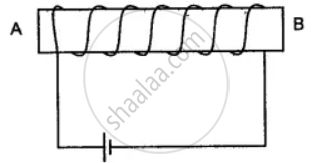
(i) What is the polarity at end A?
(ii) Give one advantage of an electromagnet over a permanent magnet.
Choose the correct option:
A conductor rod of length (l) is moving with velocity (v) in a direction normal to a uniform magnetic field (B). What will be the magnitude of induced emf produced between the ends of the moving conductor?
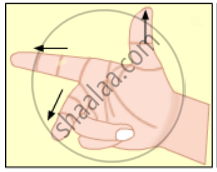
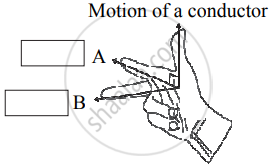
Observe the given figure of Fleming’s Right Hand Rule and write the labels of A and B correctly.
Which of the following scientist invented the rule of electromagnetic induction?
A thin semi-circular conducting ring (PQR) of radius r is falling with its plane vertical in a horizontal magnetic field B, as shown in the figure.
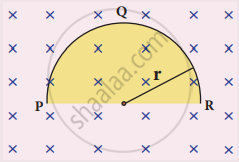
The potential difference developed across the ring when its speed v , is
State Fleming’s right-hand rule.
Show that Lenz’s law is in accordance with the law of conservation of energy.
Obtain an expression for motional emf from Lorentz force.
A square coil of side 30 cm with 500 turns is kept in a uniform magnetic field of 0.4 T. The plane of the coil is inclined at an angle of 30° to the field. Calculate the magnetic flux through the coil.
A closely wound circular coil of radius 0.02 m is placed perpendicular to the magnetic field. When the magnetic field is changed from 8000 T to 2000 T in 6 s, an emf of 44 V is induced in it. Calculate the number of turns in the coil.
An induced current of 2.5 mA flows through a single conductor of resistance 100 Ω. Find out the rate at which the magnetic flux is cut by the conductor.
A 50 cm long solenoid has 400 turns per cm. The diameter of the solenoid is 0.04 m. Find the magnetic flux linked with each turn when it carries a current of 1 A.
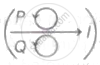
Metal rings P and Q are lying in the same plane, where current I is increasing steadily. The induced current in metal rings is shown correctly in figure.
A generator has an e.m.f. of 440 Volt and internal resistance of 4000 hm. Its terminals are connected to a load of 4000 ohm. The voltage across the load is ______.
A metal plate can be heated by ______.
For making a strong electromagnet the material of the core should be ______.
A conductor of length 50 cm carrying a current of 5 A is placed perpendicular to a magnetic field of induction 2×10 -3T. Find the force on the conductor.
The working of a dynamo is based on the principle of
Which of the following phenomena makes use of electromagnetic induction?
A conducting bar of length L is free to slide on two parallel conducting rails as shown in the figure

Two resistors R1 and R2 are connected across the ends of the rails. There is a uniform magnetic field `vec"B"` pointing into the page. An external agent pulls the bar to the left at a constant speed v. The correct statement about the directions of induced currents I1 and I2 flowing through R1 and R2 respectively is:
Show that for a given positive ion species in a cyclotron, (i) the radius of their circular path inside a dee is directly proportional to their speed, and (ii) the maximum ion energy achievable is directly proportional to the square of the magnetic induction.
Which type of force is experienced by a moving charge in a magnetic field?
What do moving electric charges produce?
Around 1830, who showed that an electric current can be induced in a closed coil exposed to a changing magnetic field?
What happens when the current in a nearby solenoid coil is switched on or off?
What did Faraday show in 1831?
What is a solenoid?
What is a changing magnetic field?
Which type of motor works on electromagnetic induction?
