Advertisements
Advertisements
प्रश्न
Draw and label the diagram of a simple D.C. motor.
(a) Explain the rotation of the coil, giving a reason for your answer.
(b) How can you reverse the direction of rotation of the armature?
(c) How can you increase the speed of rotation of the motor?
Advertisements
उत्तर

(a) The coil rotates because equal and opposi te forces act on its arms which form a couple.
(b) The direct ion of rotation of armature can be reversed by interchanging the connections at the terminals of the battery joined to the brushes of the motor.
(c) The speed of rotation of the motor can be increased by increasing the current through the coil or by increasing the number of turns in the coil and by increasing the strength of the magnetic field.
APPEARS IN
संबंधित प्रश्न
Describe different ways to induce current in a coil of wire.
Welders wear special goggles or face masks with glass windows to protect their eyes from electromagnetic radiations. Name the radiations and write the range of their frequency.
Electromagnetic induction means ______.
The switches in figure (a) and (b) are closed at t = 0 and reopened after a long time at t = t0.
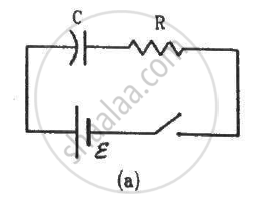
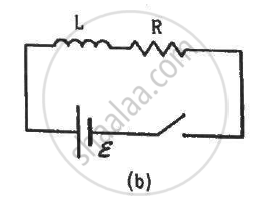
(a) The charge on C just after t = 0 is εC.
(b) The charge on C long after t = 0 is εC.
(c) The current in L just before t = t0 is ε/R.
(d) The current in L long after t = t0 is ε/R.
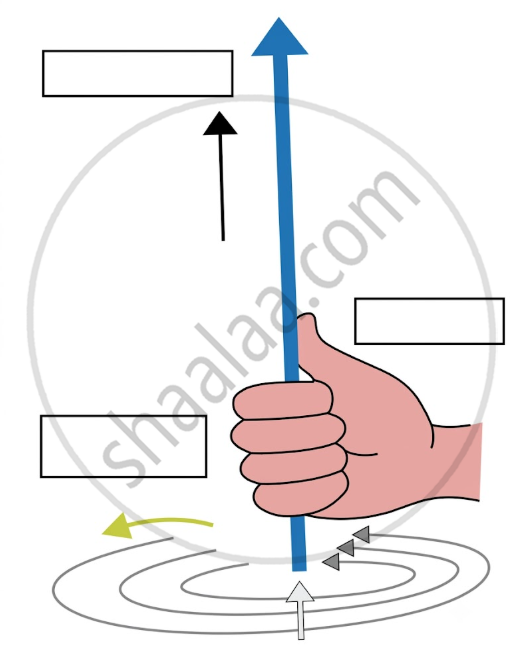
Write the two names in the following diagram.
Right hand thumb rule.
Obtain an expression for motional emf from Lorentz force.
Induced current flows through a coil ______.
When an electric current is passed through a wire or a coil, a magnetic field is produced. Is the reverse phenomenon possible i.e, can a magnetic field produce an electric current? Explain with the help of an appropriate example.
What is produced when a magnet moves towards or away from a coil?
Which movement can change the number of magnetic field lines passing through a coil near a solenoid?
