Advertisements
Advertisements
प्रश्न
Electric field intensity in free space at a distance ‘r’ outside the charged conducting sphere of radius ‘R’ in terms of surface charge density ‘ a ’ is............................
(a)`sigma / in_0[R/r]^2`
(b)`in_0/sigma[R/r]^2`
(c)`R/r[sigma/in_0]^2`
(d)`R/sigma[r/in_0]^2`
Advertisements
उत्तर
(a) `sigma / in_0[R/r]^2`
Electric field intensity in the free space outside the charged conducting sphere in terms of surface charged density is given as
`E=sigma / in_0[R/r]^2`
APPEARS IN
संबंधित प्रश्न
When a bar magnet is pushed towards (or away) from the coil connected to a galvanometer, the pointer in the galvanometer deflects. Identify the phenomenon causing this deflection and write the factors on which the amount and direction of the deflection depends. State the laws describing this phenomenon.
The phenomenon of electromagnetic induction is
A circular coil of cross-sectional area 200 cm2 and 20 turns is rotated about the vertical diameter with angular speed of 50 rad s−1 in a uniform magnetic field of magnitude 3.0 × 10⁻²T. Calculate the maximum value of the current in the coil.
State three ways in which the strength of an electromagnet can be increased.
How does an electromagnet differ forma permanent magnet?
Explain why, the core of an electromagnet should be of soft iron and not of steel.
Describe different ways to induce current in a coil of wire.
An induced current is produced when a magnet is moved into a coil. The magnitude of induced current does not depend on:
(a) the speed with which the magnet is moved
(b) the number of turns of the coil
(c) the resistivity of the wire of the coil
(d) the strength of the magnet
Describe one experiment to demonstrate the phenomenon of electromagnetic induction.
- What kind of energy change takes place when a magnet is moved towards a coil having a galvanometer at its ends?
- Name the phenomenon.
In which of the following case does the electromagnetic induction occur?
The current is stopped in a wire held near a loop of wire .
Welders wear special glass goggles while working. Why? Explain.
Welders wear special goggles or face masks with glass windows to protect their eyes from electromagnetic radiations. Name the radiations and write the range of their frequency.
Electromagnetic induction means ______.
The coil of a moving-coil galvanometer keeps on oscillating for a long time if it is deflected and released. If the ends of the coil are connected together, the oscillation stops at once. Explain.
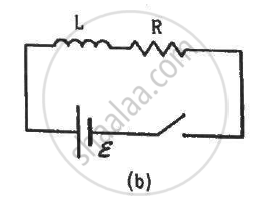
The switches in figure (a) and (b) are closed at t = 0 and reopened after a long time at t = t0.
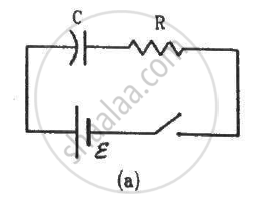
(a) The charge on C just after t = 0 is εC.
(b) The charge on C long after t = 0 is εC.
(c) The current in L just before t = t0 is ε/R.
(d) The current in L long after t = t0 is ε/R.
Calculate the dimensions of (a) \[\int \overrightarrow{E} . d \overrightarrow{l,}\] (b) vBl and (c) \[\frac{d \Phi_B}{dt}.\] The symbols have their usual meaning.
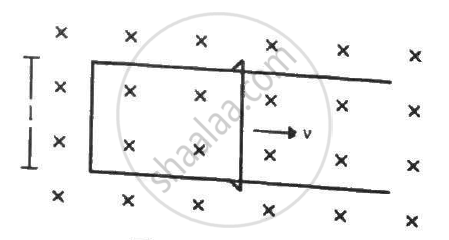
Figure shows a long U-shaped wire of width l placed in a perpendicular magnetic field B. A wire of length l is slid on the U-shaped wire with a constant velocity v towards right. The resistance of all the wires is r per unit length. At t = 0, the sliding wire is close to the left edge of the U-shaped wire. (a) Calculate the force needed to keep the sliding wire moving with a constant velocity v. (b) If the force needed just after t = 0 is F0, find the time at which the force needed will be F0/2.0
Draw and label the diagram of a simple D.C. motor.
(a) Explain the rotation of the coil, giving a reason for your answer.
(b) How can you reverse the direction of rotation of the armature?
(c) How can you increase the speed of rotation of the motor?
A transformer has 400 turns in the primary winding and 10 turns in the secondary winding. The primary e.m.f. is 250 V and the primary current is 2.0 A. calculate:
(a) The secondary voltage,
(b) The secondary current, assuming 100% efficiency.
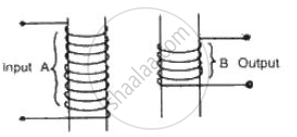
Complete the following diagram of a transformer and name the parts labeled A and B. Name the part you have drawn to complete the diagram . What is the material of this part? In this transformer a step-up or step-down? Why?
A coil has a self-inductance of 0·05 Henry. Find the magnitude of the emf induced in it when the current flowing through it is changing at the rate of 100 As-1.
Why soft iron is preferred to be used as the core of the electromagnet of an electric bell?
What is an electromagnet? What do you know about the simplest form of an electromagnet?
Draw a labelled diagram to make an electromagnet from a soft iron bar. Mark the polarity at its ends in your diagram. What precaution would you observe while making it?
You have been provided with a solenoid AB.
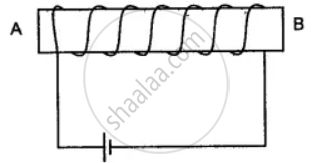
(i) What is the polarity at end A?
(ii) Give one advantage of an electromagnet over a permanent magnet.
The energy stored in a 50 mH inductor carrying a current of 4 A is ______
The right-hand thumb rule is also called _______ rule.
Fleming's left hand rule : electric current : : Fleming's right hand rule : _______
State Lenz’s law.
What for an inductor is used? Give some examples.
Show that Lenz’s law is in accordance with the law of conservation of energy.
A square coil of side 30 cm with 500 turns is kept in a uniform magnetic field of 0.4 T. The plane of the coil is inclined at an angle of 30° to the field. Calculate the magnetic flux through the coil.
A 50 cm long solenoid has 400 turns per cm. The diameter of the solenoid is 0.04 m. Find the magnetic flux linked with each turn when it carries a current of 1 A.
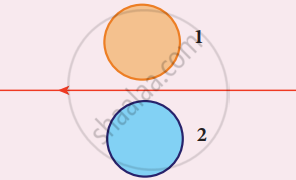
Using Lenz’s law, predict the direction of induced current in conducting rings 1 and 2 when the current in the wire is steadily decreasing.
An alternating emf of 0.2 V is applied across an L-C-R series circuit having R = 4Q, C = 80µF, and L = 200 mH. At resonance the voltage drop across the inductor is
A layer of atmosphere that reflects medium frequency radio waves which is ineffective during night, is ______.
A cylindrical bar magnet (A) and similar unmagnetized cylindrical iron bar (B) are dropped through metallic pipe. The time taken to come down by ____________.
There is a uniform magnetic field directed perpendicular and into the plane of the paper. An irregular shaped conducting loop is slowly changing into a circular loop in the plane of the paper. Then ______.
One solenoid is centered inside another. The outer one has a length of 50.0 cm and contains 6750 coils, while the coaxial inner solenoid is 3.0 cm long and π cm2 in area and contains 150 coils. The current in the outer solenoid is changing at 3000 A/s. The emf induced in the inner solenoid is ______ V.
(Round off to two decimal places.)
The primary of a transformer has 400 turns while the secondary has 2000 turns. If the power output from the secondary at 1000 Vis 12 kW, what is the primary voltage?
The charge will flow through a galvanometer of resistance 200Ω connected to a 400Ω circular coil of 1000 turns wound on a wooden stick 20 mm in diameter, if a magnetic field B = 0.012 T parallel to the axis of the stick decreased suddenly to zero, is near ______.
Which type of force is experienced by a moving charge in a magnetic field?
Which movement of a coil can produce a current?
What happens when the current in a nearby solenoid coil is switched on or off?
What did Faraday show in 1831?
What is produced when a magnet moves towards or away from a coil?
What is a solenoid?
Which type of motor works on electromagnetic induction?
