Advertisements
Advertisements
प्रश्न
Obtain an expression for motional emf from Lorentz force.
Advertisements
उत्तर
Consider a straight conducting rod AB of length l in a uniform magnetic field `vec"B"` which is directed perpendicularly into the plane of the paper. The length of the rod is normal to the magnetic field. Let the rod move with a constant velocity `vec"v"` towards right side.
When the rod moves, the free electrons present in it also move with same velocity `vec"v"` in `vec"B"`. As a result, the Lorentz force acts on free electrons in the direction from B to A and is given by the relation
`vec"F"_"B" = - "e"(vec"v" xx vec"B")` ....(1)
The action of this Lorentz force is to accumulate the free electrons at the end A. This accumulation of free electrons produces a potential difference across the rod which in turn establishes an electric field E directed along BA. Due to the electric field E, the coulomb force starts acting on the free electrons along AB and is given by
`vec"F"_"E" = - "e"vec"E"` ....(2)
The magnitude of the electric field `vec"E"` keeps on increasing as long as the accumulation of electrons at the end A continues. The force `vec"F"_"E"` also increases until equilibrium is reached. At equilibrium, the magnetic Lorentz force `vec"F"_"B"` and the coulomb force `vec"F"_"E"` balance each other and no further accumulation of free electrons at the end A takes place, i.e.,
`|vec"F"_"B"| = |vec"F"_"E"|`
`|-"e" (vec"v" xx vec"B")| = |-"e" vec"E"|`
vB sin 90° = E
vB = E ……. (3)
The potential difference between two ends of the rod is
(a) 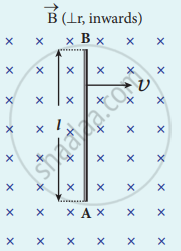
(b)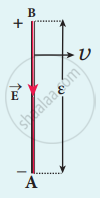
Motional emf from Lorentz force
V = El
V = vBl
Thus the Lorentz force on the free electrons is responsible to maintain this potential difference and hence produces an emf.
ε = Blv ….. (4)
As this emf is produced due to the movement of the rod, it is often called as motional emf.
APPEARS IN
संबंधित प्रश्न
An emf of 2V is induced in a coil when the current in it is changed from 0A to 10A in 0·40 sec. Find the coefficient of self-inductance of the coil.
State whether the following statement are true or false:
A generator works on the principle of electromagnetic induction.
Describe different ways to induce current in a coil of wire.
Calculate the dimensions of (a) \[\int \overrightarrow{E} . d \overrightarrow{l,}\] (b) vBl and (c) \[\frac{d \Phi_B}{dt}.\] The symbols have their usual meaning.
You have been provided with a solenoid AB.
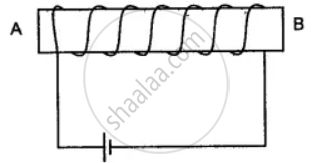
(i) What is the polarity at end A?
(ii) Give one advantage of an electromagnet over a permanent magnet.
Using Ampere's law, obtain an expression for the magnetic induction near a current-carrying straight infinitely long wire.
The right-hand thumb rule is also called _______ rule.
A metal plate can be heated by ______.
Which of the following instruments works by electromagnetic induction?
Which movement can change the number of magnetic field lines passing through a coil near a solenoid?
