Advertisements
Advertisements
Question
Obtain an expression for motional emf from Lorentz force.
Advertisements
Solution
Consider a straight conducting rod AB of length l in a uniform magnetic field `vec"B"` which is directed perpendicularly into the plane of the paper. The length of the rod is normal to the magnetic field. Let the rod move with a constant velocity `vec"v"` towards right side.
When the rod moves, the free electrons present in it also move with same velocity `vec"v"` in `vec"B"`. As a result, the Lorentz force acts on free electrons in the direction from B to A and is given by the relation
`vec"F"_"B" = - "e"(vec"v" xx vec"B")` ....(1)
The action of this Lorentz force is to accumulate the free electrons at the end A. This accumulation of free electrons produces a potential difference across the rod which in turn establishes an electric field E directed along BA. Due to the electric field E, the coulomb force starts acting on the free electrons along AB and is given by
`vec"F"_"E" = - "e"vec"E"` ....(2)
The magnitude of the electric field `vec"E"` keeps on increasing as long as the accumulation of electrons at the end A continues. The force `vec"F"_"E"` also increases until equilibrium is reached. At equilibrium, the magnetic Lorentz force `vec"F"_"B"` and the coulomb force `vec"F"_"E"` balance each other and no further accumulation of free electrons at the end A takes place, i.e.,
`|vec"F"_"B"| = |vec"F"_"E"|`
`|-"e" (vec"v" xx vec"B")| = |-"e" vec"E"|`
vB sin 90° = E
vB = E ……. (3)
The potential difference between two ends of the rod is
(a) 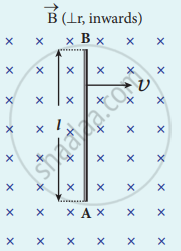
(b)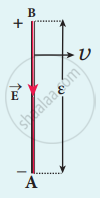
Motional emf from Lorentz force
V = El
V = vBl
Thus the Lorentz force on the free electrons is responsible to maintain this potential difference and hence produces an emf.
ε = Blv ….. (4)
As this emf is produced due to the movement of the rod, it is often called as motional emf.
APPEARS IN
RELATED QUESTIONS
State the factors on which the strength of an electromagnet depends. How does it depend on these factors?
Fig. shows a simple form of an A.C. generator.
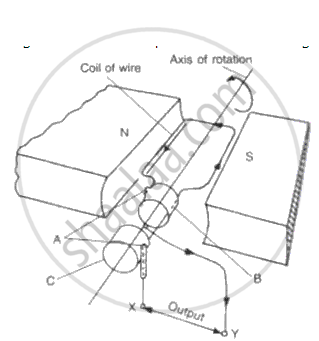
(a) Name the parts labeled A and B.
(b) What would be the effect of doubling the number of turns on the coil if the speed of rotation remains unchanged?
(c) Which of the output terminals is positive if the coil is rotating in the
direction shown in the diagram (anticlockwise)?
( d ) What is the position of the rotating coil when p.d. across its ends is zero? Explain why p.d. is zero when the coil is at this position .
(e) Sketch a graph showing how the p.d. across the ends of the rotating coil varies with time for an A.C. dynamo.
( f) On th e same sheet of paper and vertically below the first graph using the same time scale, sketch graphs to show the effect of
(i) Doubling the speed of rotation and at the same time keeping
the field and the number of turns constant,
(ii ) Doubling the number of turns on the coil and at the same time
doubling the speed of rotation of the coil, keeping th e speed
constant.
The energy stored in a 50 mH inductor carrying a current of 4 A is ______
Establish the fact that the relative motion between the coil and the magnet induces an emf in the coil of a closed circuit.
A closely wound circular coil of radius 0.02 m is placed perpendicular to the magnetic field. When the magnetic field is changed from 8000 T to 2000 T in 6 s, an emf of 44 V is induced in it. Calculate the number of turns in the coil.
What should be the core of an electromagnet?
A coil of one turn is made of a wire of certain length and then from the same length, a coil of two turns is made. If the same current is passed in both the cases, then the ratio of the magnetic inductions at their centres will be:
A sheet is placed on horizontal surface in front of a strong magnetic pole. A force is needed to:
- hold the sheet there if it is magnetic.
- hold the sheet there if it is non-magnetic.
- move the sheet away from the pole with uniform velocity if it is conducting.
- move the sheet away from the pole with uniform velocity if it is both, non-conducting and nonpolar.
Choose the correct statement(s) from the options given below:
What change can produce a current in a stationary conductor?
Which device used for producing electricity works on electromagnetic induction?
