Advertisements
Advertisements
प्रश्न
Choose the correct option:
A conductor rod of length (l) is moving with velocity (v) in a direction normal to a uniform magnetic field (B). What will be the magnitude of induced emf produced between the ends of the moving conductor?
पर्याय
BLv
BLv2
`1/2Blv`
`(2Bl)/v`
Advertisements
उत्तर
BLv
Explanation:
Step 1:
Let F = Force on charge q due to the motion of rod in the field
Therefore, `F = qVB` .....(1)
Where, q = charge on body (i.e. rod)
v = velocity of rod
B = Magnetic Field on the rod
Step 2:
This force on the charge is attributed to the induced electric field E
Therefore, `Eq = F` ......(2)
Substitute the values from (1) and (2) and calculate:
`E = V B` .....(3)
Therefore, an electric field `E = V B` is said to be induced in the rod due to the motion in the magnetic field.
Potential difference due to the field = emf induced (e) = Electric Field x Length
= `El`
Using (3),
e = `V Bl`
संबंधित प्रश्न
Electric field intensity in free space at a distance ‘r’ outside the charged conducting sphere of radius ‘R’ in terms of surface charge density ‘ a ’ is............................
(a)`sigma / in_0[R/r]^2`
(b)`in_0/sigma[R/r]^2`
(c)`R/r[sigma/in_0]^2`
(d)`R/sigma[r/in_0]^2`
State Fleming’s right-hand rule.
State three differences between direct current and alternating current.
Two circular coils A and B are placed closed to each other. If the current in the coil A is changed, will some current be induced in the coil B? Give reason.
It is desired to measure the magnitude of field between the poles of a powerful loud speaker magnet. A small flat search coil of area 2 cm2 with 25 closely wound turns, is positioned normal to the field direction, and then quickly snatched out of the field region. Equivalently, one can give it a quick 90° turn to bring its plane parallel to the field direction. The total charge flown in the coil (measured by a ballistic galvanometer connected to coil) is 7.5 mC. The combined resistance of the coil and the galvanometer is 0.50 Ω. Estimate the field strength of magnet.
If ‘R’ is the radius of dees and ‘B’ be the magnetic field of induction in which positive charges (q) of mass (m) escape from the cyclotron, then its maximum speed (vmax) is _______.
A) `(qR)/(Bm)`
B)`(qm)/(Br)`
C) `(qBR)/m`
D) `m/(qBR)`
A circular coil of cross-sectional area 200 cm2 and 20 turns is rotated about the vertical diameter with angular speed of 50 rad s−1 in a uniform magnetic field of magnitude 3.0 × 10⁻²T. Calculate the maximum value of the current in the coil.
Explain why, an electromagnet is called a temporary magnet.
State the factors on which the strength of an electromagnet depends. How does it depend on these factors?
The direction of current in the coil at one end of an electromagnet is clockwise. This end of the electromagnet will be:
(a) north pole
(b) east pole
(c) south pole
(d) west pole
What condition is necessary for the production of current by electromagnetic induction?
Describe different ways to induce current in a coil of wire.
In which of the following case does the electromagnetic induction occur?
The current is stopped in a wire held near a loop of wire .
A light metal disc on the top of an electromagnet is thrown up as the current is switched on. Why? Give reason.
The coil of a moving-coil galvanometer keeps on oscillating for a long time if it is deflected and released. If the ends of the coil are connected together, the oscillation stops at once. Explain.
Consider the energy density in a solenoid at its centre and that near its ends. Which of the two is greater?
Calculate the dimensions of (a) \[\int \overrightarrow{E} . d \overrightarrow{l,}\] (b) vBl and (c) \[\frac{d \Phi_B}{dt}.\] The symbols have their usual meaning.
Draw and label the diagram of a simple D.C. motor.
(a) Explain the rotation of the coil, giving a reason for your answer.
(b) How can you reverse the direction of rotation of the armature?
(c) How can you increase the speed of rotation of the motor?
Fill in the blanks by writing (i) Only soft iron, (ii) Only steel, (iii) Both soft-iron and steel for the material of core and/or magnet.
D.C. motor ______.
A transformer has 400 turns in the primary winding and 10 turns in the secondary winding. The primary e.m.f. is 250 V and the primary current is 2.0 A. calculate:
(a) The secondary voltage,
(b) The secondary current, assuming 100% efficiency.
Answer the following:
State the principles of the electric motor and electric generator.
What is an electromagnet?
Why soft iron is preferred to be used as the core of the electromagnet of an electric bell?
What is an electromagnet? What do you know about the simplest form of an electromagnet?
You have been provided with a solenoid AB.
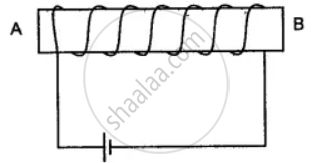
(i) What is the polarity at end A?
(ii) Give one advantage of an electromagnet over a permanent magnet.
The diagram shows a rectangular coil ABCD, suspended freely between the concave pole pieces of a permanent horseshoe magnet, such that the plane of the coil is parallel to the magnetic field.
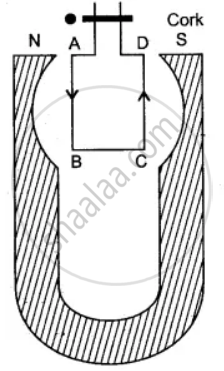
- State your observation when the current is switched on.
- Give an explanation for your observation in (i).
- State the rule, which will help you to find the motion of rotation of the coil.
- In which position will the coil ultimately come to rest?
- State four ways of increasing the magnitude of force acting on the coil.
State the condition at which we say the two coils kept close to each other are perfectly coupled with each other.
Which of the following scientist invented the rule of electromagnetic induction?
Fleming's left hand rule : electric current : : Fleming's right hand rule : _______
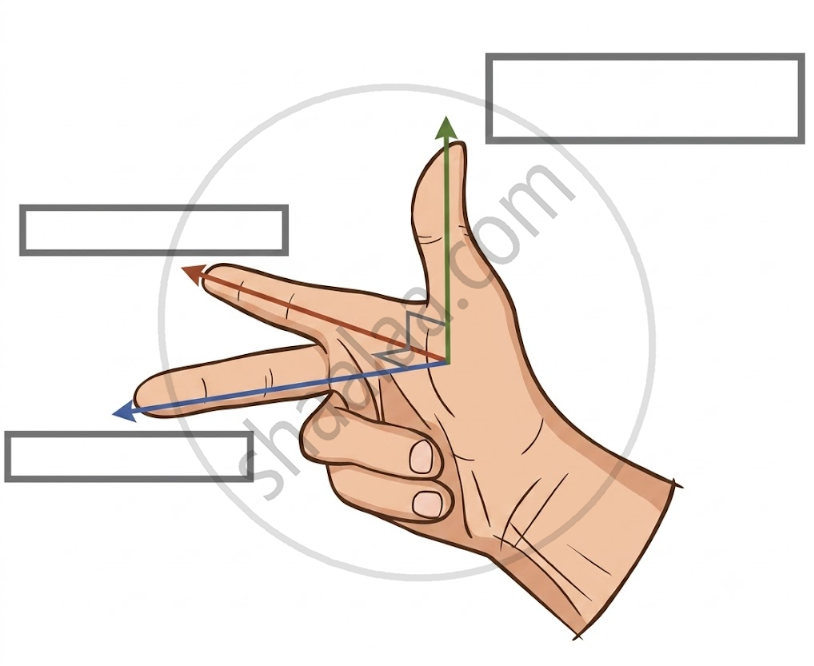
Write the two names in the following diagram.
Fleming’s right hand rule.
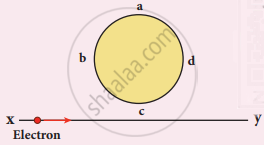
An electron moves on a straight-line path XY as shown in the figure. The coil abcd is adjacent to the path of the electron. What will be the direction of the current, if any, induced in the coil?
State Lenz’s law.
Establish the fact that the relative motion between the coil and the magnet induces an emf in the coil of a closed circuit.
Obtain an expression for motional emf from Lorentz force.
The magnetic flux passing through a coil perpendicular to its plane is a function of time and is given by OB = (2t3 + 4t2 + 8t + 8) Wb. If the resistance of the coil is 5 Ω, determine the induced current through the coil at a time t = 3 second.
A 50 cm long solenoid has 400 turns per cm. The diameter of the solenoid is 0.04 m. Find the magnetic flux linked with each turn when it carries a current of 1 A.
Using Lenz’s law, predict the direction of induced current in conducting rings 1 and 2 when the current in the wire is steadily decreasing.
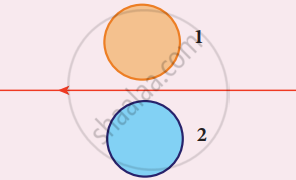
There is a uniform magnetic field directed perpendicular and into the plane of the paper. An irregular shaped conducting loop is slowly changing into a circular loop in the plane of the paper. Then ______.
The instrument that use to defect electric current in the circuit is known as ____________.
Name some equipment that uses electromagnetism for functioning.
Sea turtles return to their birth beach many decades after they were born due to ______.
A 0.4 m wire, stretched horizontally, carries an electric current of 15 A, in a magnetic field whose magnetic field intensity is 0.1 N/Am. What is the magnitude of the wire?
A conductor of length 50 cm carrying a current of 5 A is placed perpendicular to a magnetic field of induction 2×10 -3T. Find the force on the conductor.
One solenoid is centered inside another. The outer one has a length of 50.0 cm and contains 6750 coils, while the coaxial inner solenoid is 3.0 cm long and π cm2 in area and contains 150 coils. The current in the outer solenoid is changing at 3000 A/s. The emf induced in the inner solenoid is ______ V.
(Round off to two decimal places.)
An expression for oscillating electric field in a plane electromagnetic wave is given as Ez = 300 sin(5π × 103x - 3π × 1011t)Vm-1 Then, the value of magnetic field amplitude will be ______. (Given: speed of light in Vacuum c = 3 × 10⁸ ms-1)
The charge will flow through a galvanometer of resistance 200Ω connected to a 400Ω circular coil of 1000 turns wound on a wooden stick 20 mm in diameter, if a magnetic field B = 0.012 T parallel to the axis of the stick decreased suddenly to zero, is near ______.
Show that for a given positive ion species in a cyclotron, (i) the radius of their circular path inside a dee is directly proportional to their speed, and (ii) the maximum ion energy achievable is directly proportional to the square of the magnetic induction.
Around 1830, who showed that an electric current can be induced in a closed coil exposed to a changing magnetic field?
What change can produce a current in a stationary conductor?
Which change in the current of a nearby solenoid coil can produce an induced current?
What is produced when a magnet moves towards or away from a coil?
What is the current produced in a coil due to electromagnetic induction called?
Which movement can change the number of magnetic field lines passing through a coil near a solenoid?
What is a solenoid?
Which charging technology works on electromagnetic induction?
