Advertisements
Advertisements
प्रश्न
When an electric current is passed through a wire or a coil, a magnetic field is produced. Is the reverse phenomenon possible i.e, can a magnetic field produce an electric current? Explain with the help of an appropriate example.
Advertisements
उत्तर
Yes, the reserve phenomenon is possible.
Example: A changing magnetic field in one conductor causes induced current in another. This is sometimes referred to as electromagnetic induction.
APPEARS IN
संबंधित प्रश्न
Name a common device that uses electromagnets.
An emf of 2V is induced in a coil when the current in it is changed from 0A to 10A in 0·40 sec. Find the coefficient of self-inductance of the coil.
Electromagnetic induction means ______.
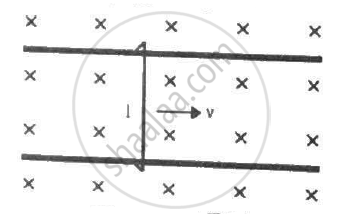
Figure shows a wire sliding on two parallel, conducting rails placed at a separation l. A magnetic field B exists in a direction perpendicular to the plane of the rails. What force is necessary to keep the wire moving at a constant velocity v?
Fill in the blanks by writing (i) Only soft iron, (ii) Only steel, (iii) Both soft-iron and steel for the material of core and/or magnet.
Transformer______.
List two ways of increasing the strength of an electromagnet if the material of the electromagnet is fixed.
Establish the fact that the relative motion between the coil and the magnet induces an emf in the coil of a closed circuit.
A conducting bar of length L is free to slide on two parallel conducting rails as shown in the figure

Two resistors R1 and R2 are connected across the ends of the rails. There is a uniform magnetic field `vec"B"` pointing into the page. An external agent pulls the bar to the left at a constant speed v. The correct statement about the directions of induced currents I1 and I2 flowing through R1 and R2 respectively is:
How were electricity and magnetism considered for a long time?
What can produce a current in a coil even when the coil does not move?
