Advertisements
Advertisements
प्रश्न
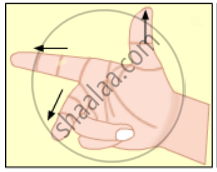
Name the following diagram and explain the concept behind it.
Advertisements
उत्तर
Name: Fleming’s right-hand rule
Concept: It represents Fleming’s right-hand rule used for finding the direction of the induced current with respect to the directions of the magnetic field and motion of the conductor.
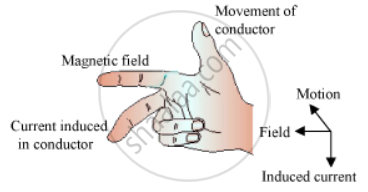
The direction of the current induced in a conductor can be obtained by holding the thumb, the index finger, and the middle finger of your right hand mutually perpendicular to each other. In this situation, the thumb indicates the direction of the motion of the conductor, the index finger points along the magnetic field, and the middle finger points along the current induced in the conductor.
APPEARS IN
संबंधित प्रश्न
A solenoid of length 1.5 m and 4 cm in diameter possesses 10 turns per metre. A current of 5 A is flowing through it. The magnetic induction at a point inside the solenoid along the axis is ............................. .
(μ0 = 4π × 10-7 Wb/Am)
- π × 10-5 T
- 2π × 10-5 T
- 3π × 10-5 T
- 4π × 10-5 T
A metal rod `1/sqrtpi `m long rotates about one of its ends perpendicular to a plane whose magnetic induction is 4 x 10⁻³ T. Calculate the number of revolutions made by the rod per second if the e.m.f. induced between the ends of the rod is 16 mV.
A horizontal straight wire 10 m long extending from east to west is falling with a speed of 5.0 m s−1, at right angles to the horizontal component of the earth’s magnetic field, 0.30 × 10⁻⁴ Wb m−2.
- What is the instantaneous value of the emf induced in the wire?
- What is the direction of the emf?
- Which end of the wire is at the higher electrical potential?
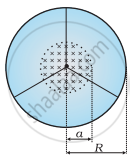
A line charge λ per unit length is lodged uniformly onto the rim of a wheel of mass M and radius R. The wheel has light non-conducting spokes and is free to rotate without friction about its axis (Figure). A uniform magnetic field extends over a circular region within the rim. It is given by,
B = − B0 k (r ≤ a; a < R)
= 0 (otherwise)
What is the angular velocity of the wheel after the field is suddenly switched off?
Name a common device that uses electromagnets.
How does an electromagnet differ forma permanent magnet?
Explain why, the core of an electromagnet should be of soft iron and not of steel.
Write some of the important uses of electromagnets.
What condition is necessary for the production of current by electromagnetic induction?
Describe different ways to induce current in a coil of wire.
Describe one experiment to demonstrate the phenomenon of electromagnetic induction.
- What kind of energy change takes place when a magnet is moved towards a coil having a galvanometer at its ends?
- Name the phenomenon.
Welders wear special goggles or face masks with glass windows to protect their eyes from electromagnetic radiations. Name the radiations and write the range of their frequency.
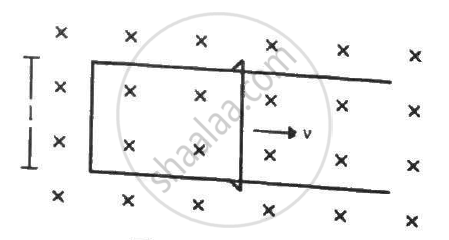
Figure shows a wire sliding on two parallel, conducting rails placed at a separation l. A magnetic field B exists in a direction perpendicular to the plane of the rails. What force is necessary to keep the wire moving at a constant velocity v?
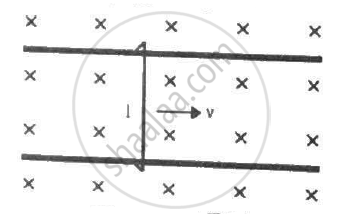
Figure shows a long U-shaped wire of width l placed in a perpendicular magnetic field B. A wire of length l is slid on the U-shaped wire with a constant velocity v towards right. The resistance of all the wires is r per unit length. At t = 0, the sliding wire is close to the left edge of the U-shaped wire. (a) Calculate the force needed to keep the sliding wire moving with a constant velocity v. (b) If the force needed just after t = 0 is F0, find the time at which the force needed will be F0/2.0
Can a transformer work when it is connected to a D.C. source? Give a reason.
Draw a simple labeled diagram of a step-down transformer.
What is an electromagnet? What do you know about the simplest form of an electromagnet?
Draw a labelled diagram to make an electromagnet from a soft iron bar. Mark the polarity at its ends in your diagram. What precaution would you observe while making it?
The diagram shows a rectangular coil ABCD, suspended freely between the concave pole pieces of a permanent horseshoe magnet, such that the plane of the coil is parallel to the magnetic field.
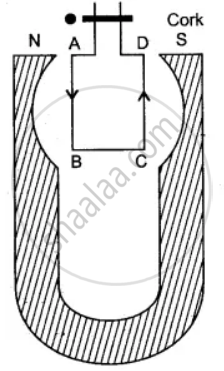
- State your observation when the current is switched on.
- Give an explanation for your observation in (i).
- State the rule, which will help you to find the motion of rotation of the coil.
- In which position will the coil ultimately come to rest?
- State four ways of increasing the magnitude of force acting on the coil.
Choose the correct option:
A conductor rod of length (l) is moving with velocity (v) in a direction normal to a uniform magnetic field (B). What will be the magnitude of induced emf produced between the ends of the moving conductor?
A thin semi-circular conducting ring (PQR) of radius r is falling with its plane vertical in a horizontal magnetic field B, as shown in the figure.
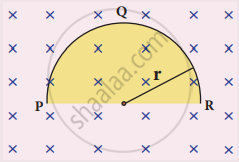
The potential difference developed across the ring when its speed v , is
Show that Lenz’s law is in accordance with the law of conservation of energy.
Shown in the figure below is a metre bridge set up with null deflection in the galvanometer. The value of the unknown resistance R is ______

A generator has an e.m.f. of 440 Volt and internal resistance of 4000 hm. Its terminals are connected to a load of 4000 ohm. The voltage across the load is ______.
What should be the core of an electromagnet?
Name some equipment that uses electromagnetism for functioning.
Induced current flows through a coil ______.
A conductor of length 50 cm carrying a current of 5 A is placed perpendicular to a magnetic field of induction 2×10 -3T. Find the force on the conductor.
One solenoid is centered inside another. The outer one has a length of 50.0 cm and contains 6750 coils, while the coaxial inner solenoid is 3.0 cm long and π cm2 in area and contains 150 coils. The current in the outer solenoid is changing at 3000 A/s. The emf induced in the inner solenoid is ______ V.
(Round off to two decimal places.)
The primary of a transformer has 400 turns while the secondary has 2000 turns. If the power output from the secondary at 1000 Vis 12 kW, what is the primary voltage?
What happens when the current in a nearby solenoid coil is switched on or off?
What did Faraday show in 1831?
What is the current produced in a coil due to electromagnetic induction called?
