Advertisements
Advertisements
Question
State the condition at which we say the two coils kept close to each other are perfectly coupled with each other.
Advertisements
Solution
When the coefficient of coupling (K) is 1, then the two coils kept close to each other are said to be perfectly coupled with each other.
APPEARS IN
RELATED QUESTIONS
A solenoid of length 1.5 m and 4 cm in diameter possesses 10 turns per metre. A current of 5 A is flowing through it. The magnetic induction at a point inside the solenoid along the axis is ............................. .
(μ0 = 4π × 10-7 Wb/Am)
- π × 10-5 T
- 2π × 10-5 T
- 3π × 10-5 T
- 4π × 10-5 T
When a bar magnet is pushed towards (or away) from the coil connected to a galvanometer, the pointer in the galvanometer deflects. Identify the phenomenon causing this deflection and write the factors on which the amount and direction of the deflection depends. State the laws describing this phenomenon.
Explain different ways to induce current in a coil.
Two circular coils A and B are placed closed to each other. If the current in the coil A is changed, will some current be induced in the coil B? Give reason.
A horizontal straight wire 10 m long extending from east to west is falling with a speed of 5.0 m s−1, at right angles to the horizontal component of the earth’s magnetic field, 0.30 × 10⁻⁴ Wb m−2.
- What is the instantaneous value of the emf induced in the wire?
- What is the direction of the emf?
- Which end of the wire is at the higher electrical potential?
An emf of 2V is induced in a coil when the current in it is changed from 0A to 10A in 0·40 sec. Find the coefficient of self-inductance of the coil.
When an electric current is passed through any wire, a magnetic field is produced around it. Then why an electric iron connecting cable does not attract nearby iron objects when electric current switched on through it?
State three ways in which the strength of an electromagnet can be increased.
How does an electromagnet differ forma permanent magnet?
When the magnet shown in the diagram below is moving towards the coil, the galvanometer gives a reading to the right.
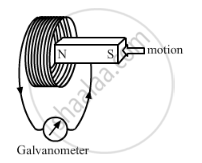
() What is the name of the effect being produced by the moving magnet?
(2) State what happens to the reading shown on the galvanometer when the magnet is moving away from the coil.
(3) The original experiment is repeated. This time the magnet is moved towards the coil at a great speed. State two changes you would notice in the reading on the galvanometer.
- What kind of energy change takes place when a magnet is moved towards a coil having a galvanometer at its ends?
- Name the phenomenon.
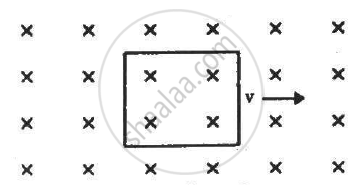
A conducting square loop of side l and resistance R moves in its plane with a uniform velocity v perpendicular to one of its sides. A uniform and constant magnetic field Bexists along the perpendicular to the plane of the loop as shown in figure. The current induced in the loop is _____________ .
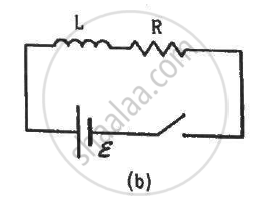
The switches in figure (a) and (b) are closed at t = 0 and reopened after a long time at t = t0.
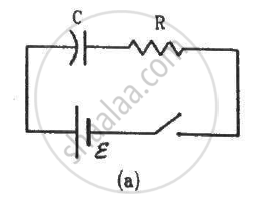
(a) The charge on C just after t = 0 is εC.
(b) The charge on C long after t = 0 is εC.
(c) The current in L just before t = t0 is ε/R.
(d) The current in L long after t = t0 is ε/R.
Calculate the dimensions of (a) \[\int \overrightarrow{E} . d \overrightarrow{l,}\] (b) vBl and (c) \[\frac{d \Phi_B}{dt}.\] The symbols have their usual meaning.
Figure shows a long U-shaped wire of width l placed in a perpendicular magnetic field B. A wire of length l is slid on the U-shaped wire with a constant velocity v towards right. The resistance of all the wires is r per unit length. At t = 0, the sliding wire is close to the left edge of the U-shaped wire. (a) Calculate the force needed to keep the sliding wire moving with a constant velocity v. (b) If the force needed just after t = 0 is F0, find the time at which the force needed will be F0/2.0
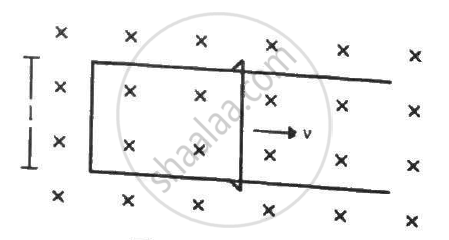
Fig. shows a simple form of an A.C. generator.
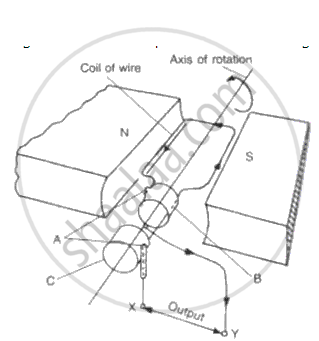
(a) Name the parts labeled A and B.
(b) What would be the effect of doubling the number of turns on the coil if the speed of rotation remains unchanged?
(c) Which of the output terminals is positive if the coil is rotating in the
direction shown in the diagram (anticlockwise)?
( d ) What is the position of the rotating coil when p.d. across its ends is zero? Explain why p.d. is zero when the coil is at this position .
(e) Sketch a graph showing how the p.d. across the ends of the rotating coil varies with time for an A.C. dynamo.
( f) On th e same sheet of paper and vertically below the first graph using the same time scale, sketch graphs to show the effect of
(i) Doubling the speed of rotation and at the same time keeping
the field and the number of turns constant,
(ii ) Doubling the number of turns on the coil and at the same time
doubling the speed of rotation of the coil, keeping th e speed
constant.
Fill in the blanks by writing (i) Only soft iron, (ii) Only steel, (iii) Both soft-iron and steel for the material of core and/or magnet.
D.C. motor ______.
Name the following diagram and explain the concept behind it.
Draw a labelled diagram to show how an electromagnet is made.
Why soft iron is preferred to be used as the core of the electromagnet of an electric bell?
The right-hand thumb rule is also called _______ rule.
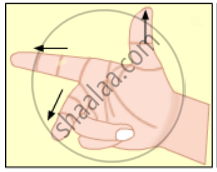
Write Fleming’s right hand thumb rule with the help of diagram.
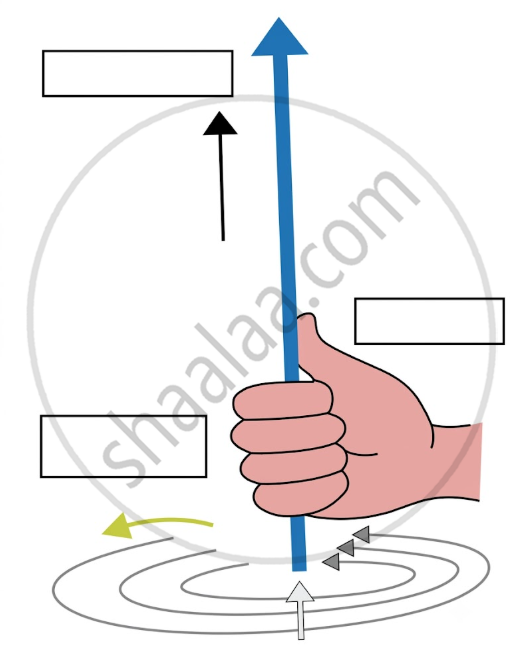
Write the two names in the following diagram.
Right hand thumb rule.
Give an illustration of determining direction of induced current by using Lenz’s law.
Show that Lenz’s law is in accordance with the law of conservation of energy.
A square coil of side 30 cm with 500 turns is kept in a uniform magnetic field of 0.4 T. The plane of the coil is inclined at an angle of 30° to the field. Calculate the magnetic flux through the coil.
A straight metal wire crosses a magnetic field of flux 4 mWb in a time 0.4 s. Find the magnitude of the emf induced in the wire.
A coil of 200 turns carries a current of 4 A. If the magnetic flux through the coil is 6 x 10⁻⁵ Wb, find the magnetic energy stored in the medium surrounding the coil.
A coil of 200 turns carries a current of 0.4 A. If the magnetic flux of 4 mWb is linked with each turn of the coil, find the inductance of the coil.
A cylindrical bar magnet (A) and similar unmagnetized cylindrical iron bar (B) are dropped through metallic pipe. The time taken to come down by ____________.
A generator has an e.m.f. of 440 Volt and internal resistance of 4000 hm. Its terminals are connected to a load of 4000 ohm. The voltage across the load is ______.
There is a uniform magnetic field directed perpendicular and into the plane of the paper. An irregular shaped conducting loop is slowly changing into a circular loop in the plane of the paper. Then ______.
A metal plate can be heated by ______.
The condition for the praenomen of electromagnetic induction is that there must be a relative motion between ____________.
We can induce the current in a coil by ____________.
What should be the core of an electromagnet?
Ansari Sir was demonstrating an experiment in his class with the setup as shown in the figure below.

A magnet is attached to a spring. The magnet can go in and out of the stationary coil. He lifted the Magnet and released it to make it oscillate through the coil.
Based on your understanding of the phenomenon, answer the following question.
What is the principle which Ansari Sir is trying to demonstrate?
Ansari Sir was demonstrating an experiment in his class with the setup as shown in the figure below.
A magnet is attached to a spring. The magnet can go in and out of the stationary coil. He lifted the Magnet and released it to make it oscillate through the coil.
Based on your understanding of the phenomenon, answer the following question.
Consider the situation where the Magnet goes in and out of the coil. State two changes which could be made to increase the deflection in the galvanometer.
Which of the following instruments works by electromagnetic induction?
For making a strong electromagnet the material of the core should be ______.
A galvanometer is an instrument that can detect the presence of a current in a circuit.
A 0.4 m wire, stretched horizontally, carries an electric current of 15 A, in a magnetic field whose magnetic field intensity is 0.1 N/Am. What is the magnitude of the wire?
A conductor of length 50 cm carrying a current of 5 A is placed perpendicular to a magnetic field of induction 2×10 -3T. Find the force on the conductor.
In the given circuit, initially switch S1 is closed and S2 and S3 are open. After charging of capacitor, at t = 0, S1 is open and S2 and S3 are closed. If the relation between inductance capacitance and resistance is L = 4CR2 then the time (in sec) after which current passing through capacitor and inductor will be same is ______ × 10-4 N. (Given R = ℓn(2)mΩ, L = 2mH)

A current I = 10 sin(100π t) A is passed in first coil, which induces a maximum e.m.f of 5π volt in second coil. The mutual inductance between the coils is ______.
An expression for oscillating electric field in a plane electromagnetic wave is given as Ez = 300 sin(5π × 103x - 3π × 1011t)Vm-1 Then, the value of magnetic field amplitude will be ______. (Given: speed of light in Vacuum c = 3 × 10⁸ ms-1)
What did Faraday show in 1831?
What is produced when a magnet moves towards or away from a coil?
What is a coil?
Which device used for producing electricity works on electromagnetic induction?
Which device used for using electricity developed from Faraday’s and Henry’s experiments?
