Advertisements
Advertisements
Question
Fig. shows a simple form of an A.C. generator.
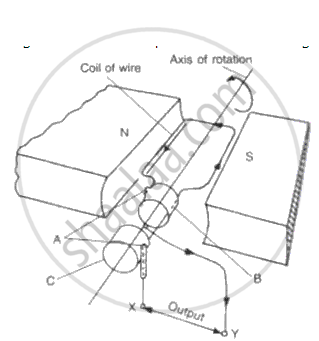
(a) Name the parts labeled A and B.
(b) What would be the effect of doubling the number of turns on the coil if the speed of rotation remains unchanged?
(c) Which of the output terminals is positive if the coil is rotating in the
direction shown in the diagram (anticlockwise)?
( d ) What is the position of the rotating coil when p.d. across its ends is zero? Explain why p.d. is zero when the coil is at this position .
(e) Sketch a graph showing how the p.d. across the ends of the rotating coil varies with time for an A.C. dynamo.
( f) On th e same sheet of paper and vertically below the first graph using the same time scale, sketch graphs to show the effect of
(i) Doubling the speed of rotation and at the same time keeping
the field and the number of turns constant,
(ii ) Doubling the number of turns on the coil and at the same time
doubling the speed of rotation of the coil, keeping th e speed
constant.
Advertisements
Solution

(b) Increasing the number of turns will increase th e current through the coil .
(c) Terminal X will be posi tive.
( d ) When the plane of the coil is normal to the magnetic field, the magnetic flux linked with the coil is maximum and the p.d. across its ends is zero.
(e ) 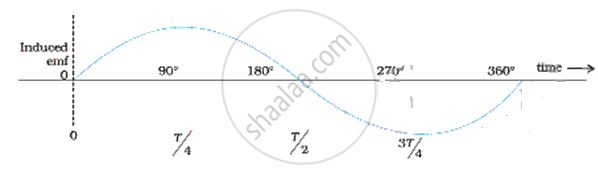
RELATED QUESTIONS
The direction of current in the coil at one end of an electromagnet is clockwise. This end of the electromagnet will be:
(a) north pole
(b) east pole
(c) south pole
(d) west pole
An induced current is produced when a magnet is moved into a coil. The magnitude of induced current does not depend on:
(a) the speed with which the magnet is moved
(b) the number of turns of the coil
(c) the resistivity of the wire of the coil
(d) the strength of the magnet
Name and state the law which determines the direction of induced current.
or
State Fleming’s right-hand rule.
The energy stored in a 50 mH inductor carrying a current of 4 A is ______
Using Ampere's law, obtain an expression for the magnetic induction near a current-carrying straight infinitely long wire.
State Lenz’s law.
Obtain an expression for motional emf from Lorentz force.
Name some equipment that uses electromagnetism for functioning.
A current I = 10 sin(100π t) A is passed in first coil, which induces a maximum e.m.f of 5π volt in second coil. The mutual inductance between the coils is ______.
Which change in the current of a nearby solenoid coil can produce an induced current?
