Advertisements
Advertisements
Questions
A horizontal straight wire 10 m long extending from east to west is falling with a speed of 5.0 m s−1, at right angles to the horizontal component of the earth’s magnetic field, 0.30 × 10⁻⁴ Wb m−2.
- What is the instantaneous value of the emf induced in the wire?
- What is the direction of the emf?
- Which end of the wire is at the higher electrical potential?
A horizontal conducting rod 10 m long extending from east to west is falling with a speed 5.0 ms–1 at right angles to the horizontal component of the Earth's magnetic field, 0.3 × 10⁻⁴ Wb m–2. Find the instantaneous value of the emf induced in the rod.
Advertisements
Solution
Length of the wire, l = 10 m
Falling speed of the wire, v = 5.0 m/s
Magnetic field strength, B = 0.3 × 10⁻⁴ Wb m–2
- Emf induced in the wire,
e = Blv
= 0.3 × 10–4 × 5 × 10
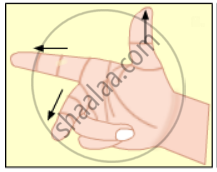
= 1.5 × 10⁻³ V - Using Fleming’s right-hand rule, it can be inferred that the direction of the induced emf is from West to East.
- The eastern end of the wire is at a higher potential.
APPEARS IN
RELATED QUESTIONS
Two circular coils A and B are placed closed to each other. If the current in the coil A is changed, will some current be induced in the coil B? Give reason.
State three ways in which the strength of an electromagnet can be increased.
When the magnet shown in the diagram below is moving towards the coil, the galvanometer gives a reading to the right.
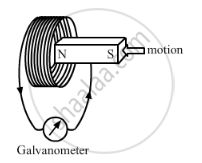
() What is the name of the effect being produced by the moving magnet?
(2) State what happens to the reading shown on the galvanometer when the magnet is moving away from the coil.
(3) The original experiment is repeated. This time the magnet is moved towards the coil at a great speed. State two changes you would notice in the reading on the galvanometer.
How is the working of an electric bell affected, if alternating current be used instead of direct current?
In which of the following case does the electromagnetic induction occur?
The current is stopped in a wire held near a loop of wire .
A conducting rod is moved with a constant velocity v in a magnetic field. A potential difference appears across the two ends _____________ .
The following diagram shows a fixed coil of several turns connected to a center zero galvanometer G and a magnet NS which can move in the direction shown in the diagram.
- Describe the observation in the galvanometer if
- The magnet is moved rapidly,
- The magnet is kept still after it has moved into the coil
- The magnet is then rapidly pulled out the coil.
- How would the observation in (i) of part (a) change if a more powerful magnet is used?

A transformer has 400 turns in the primary winding and 10 turns in the secondary winding. The primary e.m.f. is 250 V and the primary current is 2.0 A. calculate:
(a) The secondary voltage,
(b) The secondary current, assuming 100% efficiency.
Name the following diagram and explain the concept behind it.
State the condition at which we say the two coils kept close to each other are perfectly coupled with each other.
A straight metal wire crosses a magnetic field of flux 4 mWb in a time 0.4 s. Find the magnitude of the emf induced in the wire.
Shown in the figure below is a metre bridge set up with null deflection in the galvanometer. The value of the unknown resistance R is ______

A cylindrical bar magnet is kept along the axis of a circular coil. If the magnet is rotated about its axis, then ____________.
Ansari Sir was demonstrating an experiment in his class with the setup as shown in the figure below.

A magnet is attached to a spring. The magnet can go in and out of the stationary coil. He lifted the Magnet and released it to make it oscillate through the coil.
Based on your understanding of the phenomenon, answer the following question.
What is the principle which Ansari Sir is trying to demonstrate?
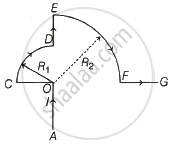
In the current carrying conductor (AOCDEFG) as shown, the magnetic induction at point O is ______.
(R1 and R2 are radii of CD and EF respectively. l = current in the loop, μ0 = permeability of free space)
What can produce a current in a coil even when the coil does not move?
What change can produce a current in a stationary conductor?
