Advertisements
Advertisements
Question
Fleming's left hand rule : electric current : : Fleming's right hand rule : _______
Advertisements
Solution
Fleming's left hand rule : electric current : : Fleming's right hand rule : direction of induced current
APPEARS IN
RELATED QUESTIONS
Electric field intensity in free space at a distance ‘r’ outside the charged conducting sphere of radius ‘R’ in terms of surface charge density ‘ a ’ is............................
(a)`sigma / in_0[R/r]^2`
(b)`in_0/sigma[R/r]^2`
(c)`R/r[sigma/in_0]^2`
(d)`R/sigma[r/in_0]^2`
State three differences between direct current and alternating current.
When a bar magnet is pushed towards (or away) from the coil connected to a galvanometer, the pointer in the galvanometer deflects. Identify the phenomenon causing this deflection and write the factors on which the amount and direction of the deflection depends. State the laws describing this phenomenon.
A rectangular wire loop of sides 8 cm and 2 cm with a small cut is moving out of a region of uniform magnetic field of magnitude 0.3 T directed normal to the loop. What is the emf developed across the cut if the velocity of the loop is 1 cm s−1 in a direction normal to the
- longer side,
- shorter side of the loop?
For how long does the induced voltage last in each case?
What is electromagnetic induction?
Prove theoretically (electromagnetic induction) `e = (dphi)/(dt)`
The north-south polarities of an electromagnet can be found easily by using:
(a) Fleming's right-hand rule
(b) Fleming's left-hand rule
(c) Clock face rule
(d) Left-hand thumb rule
The most suitable material for making the core of an electromagnet is:
(a) soft iron
(b) brass
(c) aluminium
(d) steel
State whether the following statement are true or false:
A motor works on the principle electric generator?
Name one device which works on the phenomenon of electromagnetic induction.
Describe different ways to induce current in a coil of wire.
How is the working of an electric bell affected, if alternating current be used instead of direct current?
Welders wear special glass goggles while working. Why? Explain.
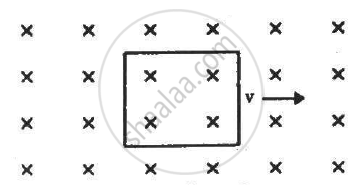
A conducting square loop of side l and resistance R moves in its plane with a uniform velocity v perpendicular to one of its sides. A uniform and constant magnetic field Bexists along the perpendicular to the plane of the loop as shown in figure. The current induced in the loop is _____________ .
Draw a labelled diagram to show how an electromagnet is made.
List two ways of increasing the strength of an electromagnet if the material of the electromagnet is fixed.
Why soft iron is preferred to be used as the core of the electromagnet of an electric bell?
Using Ampere's law, obtain an expression for the magnetic induction near a current-carrying straight infinitely long wire.
Find the odd one out and give its explanation.
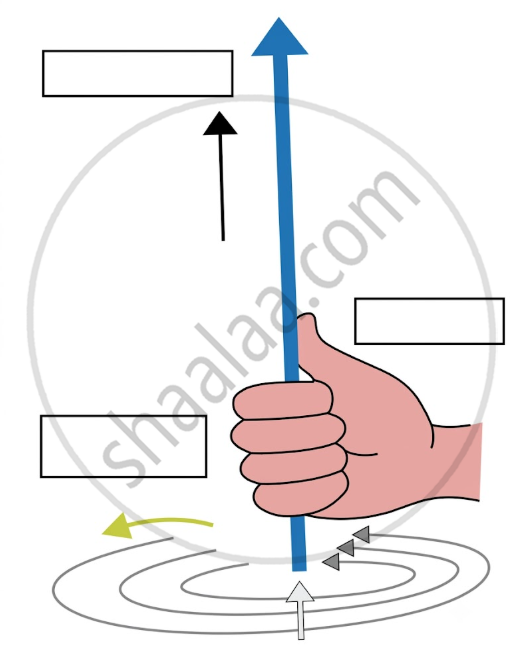
Write the two names in the following diagram.
Right hand thumb rule.
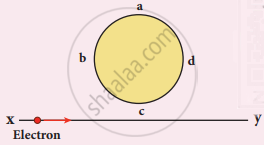
An electron moves on a straight-line path XY as shown in the figure. The coil abcd is adjacent to the path of the electron. What will be the direction of the current, if any, induced in the coil?
Establish the fact that the relative motion between the coil and the magnet induces an emf in the coil of a closed circuit.
A coil of 200 turns carries a current of 0.4 A. If the magnetic flux of 4 mWb is linked with each turn of the coil, find the inductance of the coil.
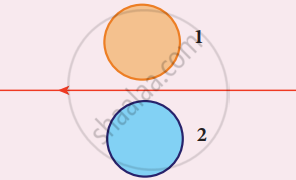
Using Lenz’s law, predict the direction of induced current in conducting rings 1 and 2 when the current in the wire is steadily decreasing.
A cylindrical bar magnet (A) and similar unmagnetized cylindrical iron bar (B) are dropped through metallic pipe. The time taken to come down by ____________.
We can induce the current in a coil by ____________.
Induced current flows through a coil ______.
A rectangular, a square, a circular and an elliptical loop, all in the (x - y) plane, are moving out of a uniform magnetic field with a constant velocity `vecv = vhati`. The magnetic field is directed along the negative z-axis direction. The induced emf, during the passage of these loops, out of the field region, will not remain constant for ______.
A conducting bar of length L is free to slide on two parallel conducting rails as shown in the figure

Two resistors R1 and R2 are connected across the ends of the rails. There is a uniform magnetic field `vec"B"` pointing into the page. An external agent pulls the bar to the left at a constant speed v. The correct statement about the directions of induced currents I1 and I2 flowing through R1 and R2 respectively is:
Show that for a given positive ion species in a cyclotron, (i) the radius of their circular path inside a dee is directly proportional to their speed, and (ii) the maximum ion energy achievable is directly proportional to the square of the magnetic induction.
How were electricity and magnetism considered for a long time?
What can produce a current in a coil even when the coil does not move?
What is a coil?
What is a solenoid?
Which charging technology works on electromagnetic induction?
