Advertisements
Advertisements
Question
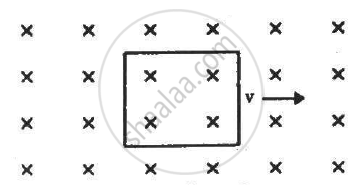
A conducting square loop of side l and resistance R moves in its plane with a uniform velocity v perpendicular to one of its sides. A uniform and constant magnetic field Bexists along the perpendicular to the plane of the loop as shown in figure. The current induced in the loop is _____________ .
Options
Blv/R clockwise
Blv/R anticlockwise
2Blv/R anticlockwise
zero
Advertisements
Solution
Zero

Figure (a) shows the square loop moving in its plane with a uniform velocity v.
Figure (b) shows the equivalent circuit.
The induced emf across ends AB and CD is given by
`E=Bvl`
On applying KVL in the equivalent circuit, we get
`E-E+iR=0`
`rArr i=0`
No current will be induced in the circuit due to zero potential difference between the closed ends.
APPEARS IN
RELATED QUESTIONS
Prove theoretically (electromagnetic induction) `e = (dphi)/(dt)`
Welders wear special goggles or face masks with glass windows to protect their eyes from electromagnetic radiations. Name the radiations and write the range of their frequency.
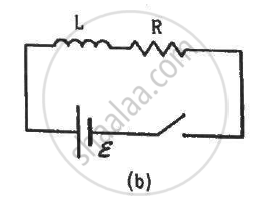
The switches in figure (a) and (b) are closed at t = 0 and reopened after a long time at t = t0.
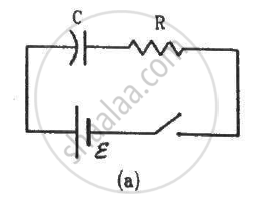
(a) The charge on C just after t = 0 is εC.
(b) The charge on C long after t = 0 is εC.
(c) The current in L just before t = t0 is ε/R.
(d) The current in L long after t = t0 is ε/R.
Can a transformer work when it is connected to a D.C. source? Give a reason.
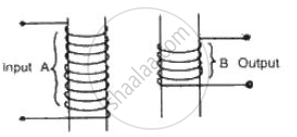
Complete the following diagram of a transformer and name the parts labeled A and B. Name the part you have drawn to complete the diagram . What is the material of this part? In this transformer a step-up or step-down? Why?
State the condition at which we say the two coils kept close to each other are perfectly coupled with each other.
The right-hand thumb rule is also called _______ rule.
Which of the following scientist invented the rule of electromagnetic induction?
A thin semi-circular conducting ring (PQR) of radius r is falling with its plane vertical in a horizontal magnetic field B, as shown in the figure.
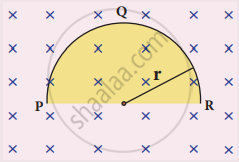
The potential difference developed across the ring when its speed v , is
State Lenz’s law.
A coil of 200 turns carries a current of 0.4 A. If the magnetic flux of 4 mWb is linked with each turn of the coil, find the inductance of the coil.
We can induce the current in a coil by ____________.
What should be the core of an electromagnet?
A coil of one turn is made of a wire of certain length and then from the same length, a coil of two turns is made. If the same current is passed in both the cases, then the ratio of the magnetic inductions at their centres will be:
An expression for oscillating electric field in a plane electromagnetic wave is given as Ez = 300 sin(5π × 103x - 3π × 1011t)Vm-1 Then, the value of magnetic field amplitude will be ______. (Given: speed of light in Vacuum c = 3 × 10⁸ ms-1)
Around 1830, who showed that an electric current can be induced in a closed coil exposed to a changing magnetic field?
Which movement can change the number of magnetic field lines passing through a coil near a solenoid?
