Advertisements
Advertisements
Question
List some of the practical applications of an electromagnet.
Advertisements
Solution
Electromagnets are used to lift heavy loads of scrap iron etc., to separate magnetic substances from non-magnetic ones and in devices like the electric bell, telegraphs, telephones, loud speakers, etc.
RELATED QUESTIONS
Explain why, the core of an electromagnet should be of soft iron and not of steel.
The direction of current in the coil at one end of an electromagnet is clockwise. This end of the electromagnet will be:
(a) north pole
(b) east pole
(c) south pole
(d) west pole
Describe one experiment to demonstrate the phenomenon of electromagnetic induction.
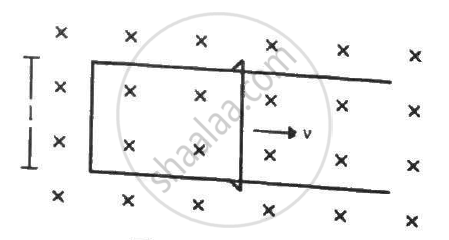
Figure shows a long U-shaped wire of width l placed in a perpendicular magnetic field B. A wire of length l is slid on the U-shaped wire with a constant velocity v towards right. The resistance of all the wires is r per unit length. At t = 0, the sliding wire is close to the left edge of the U-shaped wire. (a) Calculate the force needed to keep the sliding wire moving with a constant velocity v. (b) If the force needed just after t = 0 is F0, find the time at which the force needed will be F0/2.0
What is an electromagnet? What do you know about the simplest form of an electromagnet?
An alternating emf of 0.2 V is applied across an L-C-R series circuit having R = 4Q, C = 80µF, and L = 200 mH. At resonance the voltage drop across the inductor is
If the sun radiates energy at the rate of 3.6 × 1033 ergs/sec the rate at which the sun is loosing mass is given by ______.
A conducting bar of length L is free to slide on two parallel conducting rails as shown in the figure

Two resistors R1 and R2 are connected across the ends of the rails. There is a uniform magnetic field `vec"B"` pointing into the page. An external agent pulls the bar to the left at a constant speed v. The correct statement about the directions of induced currents I1 and I2 flowing through R1 and R2 respectively is:
What do moving electric charges produce?
What is a coil?
