Advertisements
Advertisements
Question
State Fleming’s right-hand rule.
Advertisements
Solution
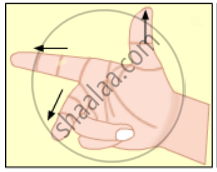
Fleming’s right-hand rule:-
Stretch the thumb, forefinger and middle finger of the right hand so that they are perpendicular to each other. If the forefinger indicates the direction of the magnetic field and the thumb shows the direction of motion of the conductor, then the middle finger will show the direction of the induced current.
APPEARS IN
RELATED QUESTIONS
Electric field intensity in free space at a distance ‘r’ outside the charged conducting sphere of radius ‘R’ in terms of surface charge density ‘ a ’ is............................
(a)`sigma / in_0[R/r]^2`
(b)`in_0/sigma[R/r]^2`
(c)`R/r[sigma/in_0]^2`
(d)`R/sigma[r/in_0]^2`
The magnetic flux through a loop varies according to the relation Φ = 8t2 + 6t + C, where ‘C’ is constant, 'Φ' is in milliweber and 't' is in second. What is the magnitude of induced e.m.f. in the loop at t = 2 seconds.
Two circular coils A and B are placed closed to each other. If the current in the coil A is changed, will some current be induced in the coil B? Give reason.
It is desired to measure the magnitude of field between the poles of a powerful loud speaker magnet. A small flat search coil of area 2 cm2 with 25 closely wound turns, is positioned normal to the field direction, and then quickly snatched out of the field region. Equivalently, one can give it a quick 90° turn to bring its plane parallel to the field direction. The total charge flown in the coil (measured by a ballistic galvanometer connected to coil) is 7.5 mC. The combined resistance of the coil and the galvanometer is 0.50 Ω. Estimate the field strength of magnet.
The magnetic flux through a loop is varying according to a relation `phi = 6t^2 + 7t + 1` where `phi` is in milliweber and t is in second. What is the e.m.f. induced in the loop at t = 2 second?
State three ways in which the strength of an electromagnet can be increased.
How does an electromagnet differ forma permanent magnet?
The direction of current in the coil at one end of an electromagnet is clockwise. This end of the electromagnet will be:
(a) north pole
(b) east pole
(c) south pole
(d) west pole
What condition is necessary for the production of current by electromagnetic induction?
Describe different ways to induce current in a coil of wire.
Name and state the law which determines the direction of induced current.
or
State Fleming’s right-hand rule.
Electromagnetic induction means ______.
Draw a simple labeled diagram of a step-down transformer.
Draw and label the diagram of a simple D.C. motor.
(a) Explain the rotation of the coil, giving a reason for your answer.
(b) How can you reverse the direction of rotation of the armature?
(c) How can you increase the speed of rotation of the motor?
Fill in the blanks by writing (i) Only soft iron, (ii) Only steel, (iii) Both soft-iron and steel for the material of core and/or magnet.
D.C. motor ______.
Name the following diagram and explain the concept behind it.
A coil has a self-inductance of 0·05 Henry. Find the magnitude of the emf induced in it when the current flowing through it is changing at the rate of 100 As-1.
State the purpose of soft iron core used in making an electromagnet.
List some of the practical applications of an electromagnet.
The diagram shows a rectangular coil ABCD, suspended freely between the concave pole pieces of a permanent horseshoe magnet, such that the plane of the coil is parallel to the magnetic field.
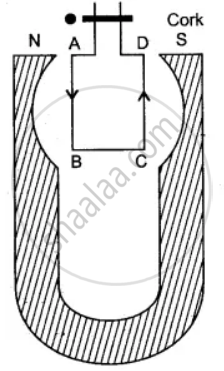
- State your observation when the current is switched on.
- Give an explanation for your observation in (i).
- State the rule, which will help you to find the motion of rotation of the coil.
- In which position will the coil ultimately come to rest?
- State four ways of increasing the magnitude of force acting on the coil.
Choose the correct option:
A conductor rod of length (l) is moving with velocity (v) in a direction normal to a uniform magnetic field (B). What will be the magnitude of induced emf produced between the ends of the moving conductor?
Fleming's left hand rule : electric current : : Fleming's right hand rule : _______
Find the odd one out and give its explanation.
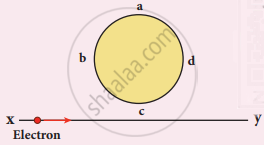
An electron moves on a straight-line path XY as shown in the figure. The coil abcd is adjacent to the path of the electron. What will be the direction of the current, if any, induced in the coil?
Establish the fact that the relative motion between the coil and the magnet induces an emf in the coil of a closed circuit.
A square coil of side 30 cm with 500 turns is kept in a uniform magnetic field of 0.4 T. The plane of the coil is inclined at an angle of 30° to the field. Calculate the magnetic flux through the coil.
A straight metal wire crosses a magnetic field of flux 4 mWb in a time 0.4 s. Find the magnitude of the emf induced in the wire.
A closely wound circular coil of radius 0.02 m is placed perpendicular to the magnetic field. When the magnetic field is changed from 8000 T to 2000 T in 6 s, an emf of 44 V is induced in it. Calculate the number of turns in the coil.
A cylindrical bar magnet is kept along the axis of a circular coil. If the magnet is rotated about its axis, then ____________.
There is a uniform magnetic field directed perpendicular and into the plane of the paper. An irregular shaped conducting loop is slowly changing into a circular loop in the plane of the paper. Then ______.
Name some equipment that uses electromagnetism for functioning.
Induced current flows through a coil ______.
AB is a coil of copper wire having a large number of turns. The ends of the coil are connected with a galvanometer as shown. When the north pole of a strong bar magnet is moved towards end B of the coil, a deflection is observed in the galvanometer.

- State the reason for using galvanometer in the activity and why does its needle deflects momentarily when magnet is moved towards the coil.
- What would be observed in the galvanometer in a situation when the coil and the bar magnet both move with the same speed in the same direction? Justify your answer.
- State the conclusion that can be drawn from this activity.
Will there be any change in the momentary deflection in the galvanometer if number of turns in the coil is increased and a more stronger magnet is moved towards the coil?
OR
What is electromagnetic induction? What is observed in the galvanometer when a strong bar magnet is held stationary near one end of a coil of large number of turns? Justify your answer.
One solenoid is centered inside another. The outer one has a length of 50.0 cm and contains 6750 coils, while the coaxial inner solenoid is 3.0 cm long and π cm2 in area and contains 150 coils. The current in the outer solenoid is changing at 3000 A/s. The emf induced in the inner solenoid is ______ V.
(Round off to two decimal places.)
What is the current produced in a coil due to electromagnetic induction called?
