Advertisements
Advertisements
Question
The magnetic flux passing through a coil perpendicular to its plane is a function of time and is given by OB = (2t3 + 4t2 + 8t + 8) Wb. If the resistance of the coil is 5 Ω, determine the induced current through the coil at a time t = 3 second.
Advertisements
Solution
Magnetic flux (ΦB) = (2t3 + 8t2 + 8t + 8)Wb
Resistance of the coil (R) = 5 Ω
time (t) = 3 second
Induced current through the coil, I = `"e"/"R"`
Induced emf, e = `("d"Φ_"B")/"dt" = "d"/"dt"` ((2t3 + 4t2 + 8t + 8) = 6t2 + 8t + 8
Here time (t) = 3 second
e = 6(3)2 + 8 × 3 + 8 = 54 + 24 + 8 = 86 V
∴ Induced current through the coil, I = `"e"/"R" = 86/5 = 17.2`A
APPEARS IN
RELATED QUESTIONS
State the factors on which the strength of an electromagnet depends. How does it depend on these factors?
When current is 'switched on' and 'switched off' in a coil, a current is induced in another coil kept near it. What is this phenomenon known as?
A coil has a self-inductance of 0·05 Henry. Find the magnitude of the emf induced in it when the current flowing through it is changing at the rate of 100 As-1.
Draw a labelled diagram to show how an electromagnet is made.
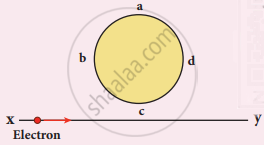
An electron moves on a straight-line path XY as shown in the figure. The coil abcd is adjacent to the path of the electron. What will be the direction of the current, if any, induced in the coil?
State Lenz’s law.
What for an inductor is used? Give some examples.
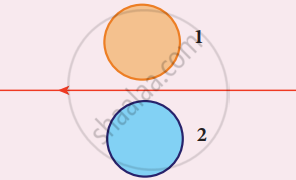
Using Lenz’s law, predict the direction of induced current in conducting rings 1 and 2 when the current in the wire is steadily decreasing.
The primary of a transformer has 400 turns while the secondary has 2000 turns. If the power output from the secondary at 1000 Vis 12 kW, what is the primary voltage?
