Advertisements
Advertisements
Question
A straight metal wire crosses a magnetic field of flux 4 mWb in a time 0.4 s. Find the magnitude of the emf induced in the wire.
Advertisements
Solution
Given data:
dΦ = 4 mWb = 4 × 10⁻³
dt = 0.4 s
induced emf ε = ?
ε = + `("d"phi)/"dt"`
`therefore = (4 xx 10^-3)/0.4 = 40/4 xx 10^-3`
ε = 10 mV
APPEARS IN
RELATED QUESTIONS
When an electric current is passed through any wire, a magnetic field is produced around it. Then why an electric iron connecting cable does not attract nearby iron objects when electric current switched on through it?
What is an electromagnet? Describe the construction and working of an electromagnet with the help of a labelled diagram.
A conducting square loop of side l and resistance R moves in its plane with a uniform velocity v perpendicular to one of its sides. A uniform and constant magnetic field Bexists along the perpendicular to the plane of the loop as shown in figure. The current induced in the loop is _____________ .
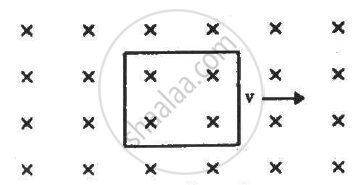
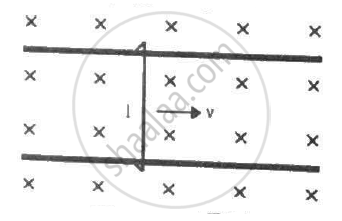
Figure shows a wire sliding on two parallel, conducting rails placed at a separation l. A magnetic field B exists in a direction perpendicular to the plane of the rails. What force is necessary to keep the wire moving at a constant velocity v?
Draw and label the diagram of a simple D.C. motor.
(a) Explain the rotation of the coil, giving a reason for your answer.
(b) How can you reverse the direction of rotation of the armature?
(c) How can you increase the speed of rotation of the motor?
A metal plate can be heated by ______.
Name some equipment that uses electromagnetism for functioning.
AB is a coil of copper wire having a large number of turns. The ends of the coil are connected with a galvanometer as shown. When the north pole of a strong bar magnet is moved towards end B of the coil, a deflection is observed in the galvanometer.

- State the reason for using galvanometer in the activity and why does its needle deflects momentarily when magnet is moved towards the coil.
- What would be observed in the galvanometer in a situation when the coil and the bar magnet both move with the same speed in the same direction? Justify your answer.
- State the conclusion that can be drawn from this activity.
Will there be any change in the momentary deflection in the galvanometer if number of turns in the coil is increased and a more stronger magnet is moved towards the coil?
OR
What is electromagnetic induction? What is observed in the galvanometer when a strong bar magnet is held stationary near one end of a coil of large number of turns? Justify your answer.
What can produce a current in a coil even when the coil does not move?
