Advertisements
Advertisements
प्रश्न
The magnetic flux passing through a coil perpendicular to its plane is a function of time and is given by OB = (2t3 + 4t2 + 8t + 8) Wb. If the resistance of the coil is 5 Ω, determine the induced current through the coil at a time t = 3 second.
Advertisements
उत्तर
Magnetic flux (ΦB) = (2t3 + 8t2 + 8t + 8)Wb
Resistance of the coil (R) = 5 Ω
time (t) = 3 second
Induced current through the coil, I = `"e"/"R"`
Induced emf, e = `("d"Φ_"B")/"dt" = "d"/"dt"` ((2t3 + 4t2 + 8t + 8) = 6t2 + 8t + 8
Here time (t) = 3 second
e = 6(3)2 + 8 × 3 + 8 = 54 + 24 + 8 = 86 V
∴ Induced current through the coil, I = `"e"/"R" = 86/5 = 17.2`A
APPEARS IN
संबंधित प्रश्न
How does an electromagnet differ forma permanent magnet?
In which of the following case does the electromagnetic induction occur?
A loop of wire is held near a magnet.
Name and state the law which determines the direction of induced current.
or
State Fleming’s right-hand rule.
Can a transformer work when it is connected to a D.C. source? Give a reason.
The following diagram shows a fixed coil of several turns connected to a center zero galvanometer G and a magnet NS which can move in the direction shown in the diagram.
- Describe the observation in the galvanometer if
- The magnet is moved rapidly,
- The magnet is kept still after it has moved into the coil
- The magnet is then rapidly pulled out the coil.
- How would the observation in (i) of part (a) change if a more powerful magnet is used?

List some of the practical applications of an electromagnet.
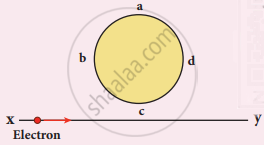
An electron moves on a straight-line path XY as shown in the figure. The coil abcd is adjacent to the path of the electron. What will be the direction of the current, if any, induced in the coil?
A sheet is placed on horizontal surface in front of a strong magnetic pole. A force is needed to:
- hold the sheet there if it is magnetic.
- hold the sheet there if it is non-magnetic.
- move the sheet away from the pole with uniform velocity if it is conducting.
- move the sheet away from the pole with uniform velocity if it is both, non-conducting and nonpolar.
Choose the correct statement(s) from the options given below:
Around 1830, who showed that an electric current can be induced in a closed coil exposed to a changing magnetic field?
