Advertisements
Advertisements
प्रश्न
The following diagram shows a fixed coil of several turns connected to a center zero galvanometer G and a magnet NS which can move in the direction shown in the diagram.
- Describe the observation in the galvanometer if
- The magnet is moved rapidly,
- The magnet is kept still after it has moved into the coil
- The magnet is then rapidly pulled out the coil.
- How would the observation in (i) of part (a) change if a more powerful magnet is used?

Advertisements
उत्तर
-
- When the magnet is moved rapidly in the direction of arrow, the magnetic flux linked with the coil changes and there is a deflection in the galvanometer, indicating a flow of current through the coil.
- On keeping the magnet still, the magnetic flux linked with the coil does not change and there is no deflection in the galvanometer, indicating that no current is flowing through the coil.
- When the magnet is rapidly pulled out, there is again change in the magnetic flux linked with the coil and the galvanometer shows a deflection but this time in opposite direction, indicating that a current is flowing in opposite direction in the coil.
- If a more powerful magnet is used, deflection in the galvanometer will be large, indicating a greater amount of current.
APPEARS IN
संबंधित प्रश्न
Describe different ways to induce current in a coil of wire.
Consider the energy density in a solenoid at its centre and that near its ends. Which of the two is greater?
Fill in the blanks by writing (i) Only soft iron, (ii) Only steel, (iii) Both soft-iron and steel for the material of core and/or magnet.
Transformer______.
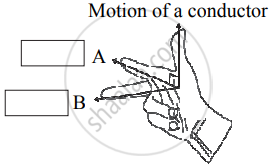
Observe the given figure of Fleming’s Right Hand Rule and write the labels of A and B correctly.
A 50 cm long solenoid has 400 turns per cm. The diameter of the solenoid is 0.04 m. Find the magnetic flux linked with each turn when it carries a current of 1 A.
A coil of 200 turns carries a current of 0.4 A. If the magnetic flux of 4 mWb is linked with each turn of the coil, find the inductance of the coil.
A conductor of length 50 cm carrying a current of 5 A is placed perpendicular to a magnetic field of induction 2×10 -3T. Find the force on the conductor.
When an electric current is passed through a wire or a coil, a magnetic field is produced. Is the reverse phenomenon possible i.e, can a magnetic field produce an electric current? Explain with the help of an appropriate example.
Which change in the current of a nearby solenoid coil can produce an induced current?
What is a coil?
