Advertisements
Advertisements
Question
Advertisements
Solution
The ratio of number of turns NS in secondary coil to the number of turns NP in the primary coil (NS / NP) is called the turns ratio.
A transformer cannot be used with direct current (d.c.) since its working is based on the principle that when there is a change of magnetic field lines due to varying current of same in one coil, an induced varying current of same frequency flows in the other coil. If the current in one coil is constant (i.e. d.c.), no induced current will flow in the other coil since there will be no change in the magnetic field lines linked with the coil.
APPEARS IN
RELATED QUESTIONS
What is an electromagnet? Describe the construction and working of an electromagnet with the help of a labelled diagram.
The north-south polarities of an electromagnet can be found easily by using:
(a) Fleming's right-hand rule
(b) Fleming's left-hand rule
(c) Clock face rule
(d) Left-hand thumb rule
In which of the following case does the electromagnetic induction occur?
A magnet is moved through a loop of wire .
Electromagnetic induction means ______.
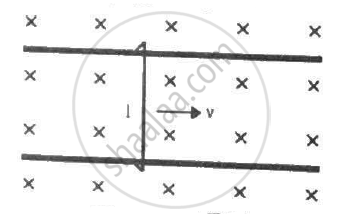
Figure shows a wire sliding on two parallel, conducting rails placed at a separation l. A magnetic field B exists in a direction perpendicular to the plane of the rails. What force is necessary to keep the wire moving at a constant velocity v?
There is a uniform magnetic field directed perpendicular and into the plane of the paper. An irregular shaped conducting loop is slowly changing into a circular loop in the plane of the paper. Then ______.
Name some equipment that uses electromagnetism for functioning.
A rectangular, a square, a circular and an elliptical loop, all in the (x - y) plane, are moving out of a uniform magnetic field with a constant velocity `vecv = vhati`. The magnetic field is directed along the negative z-axis direction. The induced emf, during the passage of these loops, out of the field region, will not remain constant for ______.
What do moving electric charges produce?
Around 1830, who showed that an electric current can be induced in a closed coil exposed to a changing magnetic field?
