Advertisements
Advertisements
Question
- What kind of energy change takes place when a magnet is moved towards a coil having a galvanometer at its ends?
- Name the phenomenon.
Advertisements
Solution
- Mechanical energy changes to electrical energy.
- Electromagnetic induction is a phenomenon.
APPEARS IN
RELATED QUESTIONS
The phenomenon of electromagnetic induction is
Name one device which works on the phenomenon of electromagnetic induction.
In which of the following case does the electromagnetic induction occur?
A magnet is moved through a loop of wire .
A light metal disc on the top of an electromagnet is thrown up as the current is switched on. Why? Give reason.
Calculate the dimensions of (a) \[\int \overrightarrow{E} . d \overrightarrow{l,}\] (b) vBl and (c) \[\frac{d \Phi_B}{dt}.\] The symbols have their usual meaning.
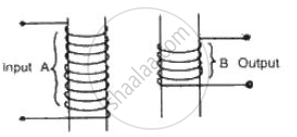
Complete the following diagram of a transformer and name the parts labeled A and B. Name the part you have drawn to complete the diagram . What is the material of this part? In this transformer a step-up or step-down? Why?
Draw a labelled diagram to make an electromagnet from a soft iron bar. Mark the polarity at its ends in your diagram. What precaution would you observe while making it?
An expression for oscillating electric field in a plane electromagnetic wave is given as Ez = 300 sin(5π × 103x - 3π × 1011t)Vm-1 Then, the value of magnetic field amplitude will be ______. (Given: speed of light in Vacuum c = 3 × 10⁸ ms-1)
The charge will flow through a galvanometer of resistance 200Ω connected to a 400Ω circular coil of 1000 turns wound on a wooden stick 20 mm in diameter, if a magnetic field B = 0.012 T parallel to the axis of the stick decreased suddenly to zero, is near ______.
What do moving electric charges produce?
