Advertisements
Advertisements
Question
- How would you demonstrate that a momentary current can be obtained by the suitable use of a magnet, a coil of wire and a galvanometer?
- What is the source of energy associated with the current obtained in part (a)?
Advertisements
Solution
-
Move the N-pole of the magnet along the coil, until it reaches the B-end of the coil that is linked to the center zero galvanometer. To indicate that current is flowing in the coil, the pointer deflects to the right. An increase in the rate of current production occurs when the N-pole is moved closer to B, meaning that the coil and magnet are moving relative to one another. No such current is generated and the pointer stays at zero when both are at rest.
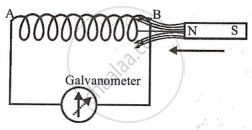
-
The source of energy associated with the current obtained in part (a) is mechanical energy.
APPEARS IN
RELATED QUESTIONS
A.C generator works on the principle of ____________.
Fleming’s left-hand rule is also known as the dynamo rule.
A vertical electric field of magnitude 4.9 × 10⁵ N/C just prevents a water droplet of a mass 0.1 g from falling. The value of charge on the droplet will be: (Given g = 9.8 m/s2).
For which angle between two equal vectors `vec"A"` and `vec"B"` will the magnitude of the sum of two vectors be equal to the magnitude of each vector?
A circular loop is placed in a uniform magnetic field. The total number of magnetic field lines passing normally through the plane of the coil is called ______.
State the use of the principle of electromagnetic induction.
An infinitely long cylinder is kept parallel to an uniform magnetic field B directed along positive z axis. The direction of induced current as seen from the z axis will be ______.
What did the experiments of Michael Faraday and Joseph Henry around 1830 demonstrate?
What is \[N\Phi_B\] called, and what is its unit?
