Advertisements
Advertisements
प्रश्न
- How would you demonstrate that a momentary current can be obtained by the suitable use of a magnet, a coil of wire and a galvanometer?
- What is the source of energy associated with the current obtained in part (a)?
Advertisements
उत्तर
-
Move the N-pole of the magnet along the coil, until it reaches the B-end of the coil that is linked to the center zero galvanometer. To indicate that current is flowing in the coil, the pointer deflects to the right. An increase in the rate of current production occurs when the N-pole is moved closer to B, meaning that the coil and magnet are moving relative to one another. No such current is generated and the pointer stays at zero when both are at rest.
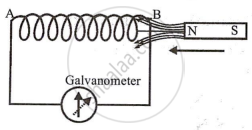
-
The source of energy associated with the current obtained in part (a) is mechanical energy.
APPEARS IN
संबंधित प्रश्न
State Lenz’s Law.
The direction of induced current is obtained by ______.
The diagram in shows a coil of several turns of copper wire near a magnet NS. The coil is moved in the direction of arrow shown in the diagram.
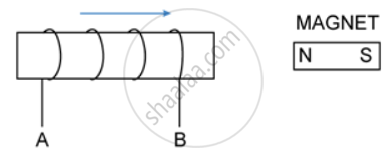
- In what direction does the induced current flow in the coil?
- Name the law used to arrive at the conclusion in part (i).
- How would the current in coil be altered if
- the coil has twice the number of turns,
- the coil was made to move three times fast?
Fleming’s left-hand rule is also known as the dynamo rule.
Under what condition is an electric current induced in a coil?
If magnetic flux is measured in weber and time in seconds, what is the unit of induced emf?
What happens when changing magnetic flux passes through a coil that is an open circuit with infinite resistance?
What does induction in an open circuit show about the cause of induced emf?
What does the negative sign in Faraday’s First Law indicate?
If the magnetic field across a loop decreases to zero, what is the final magnetic flux through the loop?
