Advertisements
Advertisements
प्रश्न
State Lenz’s Law.
Advertisements
उत्तर १
It is stated that the direction of induced e.m.f. is always in such a direction that it opposes the change in magnetic flux.
e = `(d phi)/(dt)`
Consider a rectangular metal coil PQRS. Let ‘L’ be the length of the coil. It is placed in a partly magnetic field ‘B’. The direction of the magnetic field is perpendicular to the paper and into the paper. The ‘x’ part of the coil is in the magnetic field at instant t. If the coil is moved towards the right with a velocity v = `dx/dt` with the help of an external agent, such as a hand. The magnetic flux through the coil is:
Φ = BA = BLx
∴ Φ = BLx ...(1)
There is relative motion of a current through the coil. Let ‘i’ be current through the coil.
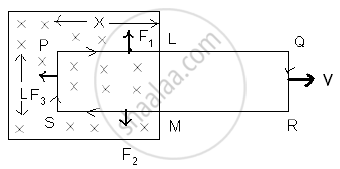
Three forces act on the coil.
F1 on conductor PL ∴ F1 = Bi x, vertically upward.
F2 on conductor MS ∴ F2 = Bi x, vertically downward.
F3 on conductor SP ∴ F3 = Bi L towards left.
F1 and F2 are equal and opposite and also on the same line. They will cancel each other; F3 is a resultant force. The external agent has to do work against this force.
∴ F3 = −Bi l ...(−ve sign indicates that force is opposite to dx.)
If dx is the displacement in time dt, then the work done (dw) = F3 dx.
∴ dw = − BiL dx
This power is an electrical energy ‘ei’ where ‘e’ is an induced e.m.f.
∴ ei = `-(B_i ldx)/(dt)`
∴ e = `-(BLdx)/(dt)`
∴ e = −BLv
∴ e = `-d/dt (BLx)`
∴ e = `(-d phi)/(dt)` ...[from eq (1)]
उत्तर २
Lenz’s Law states that the direction of the induced electromotive force (EMF) and the resulting current in a conductor is always such that it opposes the change in magnetic flux that caused it.
Mathematically, Lenz’s Law is expressed as:
ε = `(-d phi_B)/dt`
Where,
ε = Induced EMF
ΦB = Magnetic flux
The negative sign indicates opposition to the change in flux.
Notes
Students can refer to the provided solutions based on their preferred marks.
APPEARS IN
संबंधित प्रश्न
State Faraday’s laws of electromagnetic induction.
In which of the following case does the electromagnetic induction occur?
What is Lenz’s law?
The direction of induced current is obtained by ______.
Explain the principle, construction and working of a dc motor.
A magnet is moved towards a coil (i) quickly (ii) slowly. The induced potential difference.
Fleming’s left hand and Right hand rules are used in ____________.
A D.C generator works on the principle of ____________.
The laws of induction were given by ______.
Fleming’s left-hand rule is also known as the dynamo rule.
Define the right-hand thumb rule.
Two vectors `vec"A"` and `vec"B"` have equal magnitudes. If magnitude of `vec"A"` + `vec"B"` is equal to two times the magnitude of `vec"A"` - `vec"B"`, then the angle between `vec"A"` and `vec"B"` will be ______.
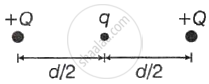
Two positively charged particles each having charge Q and are d distance apart. A third charge is introduced in midway on the line joining the two. Find nature and magnitude of third charge, so that the system is in equilibrium ______.
Express Faraday-Lenz's law of electromagnetic induction in an equation form.
A conductor in the form of a circular arc of the radius of curvature R subtends an angle Ø at its centre of curvature. If the current in the conduct is I, the magnetic induction at the centre of curvature is ______.
Name the principle of AC generator.
State the use of the principle of electromagnetic induction.
The magnetic flux through a coil perpendicular to its plane is varying according to the relation Φ = (5t3 + 4t2 + 2t − 5) Weber. If the resistant of the coil is 5 ohm, then the induced current through the coil at t = 2 sec will be ______.
An infinitely long cylinder is kept parallel to an uniform magnetic field B directed along positive z axis. The direction of induced current as seen from the z axis will be ______.
What did the experiments of Oersted, Ampere, and others establish about moving electric charges?
What did the experiments of Michael Faraday and Joseph Henry around 1830 demonstrate?
Under what condition is an electric current induced in a coil?
What is the current produced in a coil by changing magnetic flux called?
What does Faraday’s First Law or Neumann’s law state about the magnitude of induced emf?
What is \[N\Phi_B\] called, and what is its unit?
What changes when either a coil or a nearby magnet is moved so that their relative position changes?
When is an emf induced as a magnet moves towards or away from a coil?
What is the induced emf if both a magnet and a coil remain stationary?
What happens when changing magnetic flux passes through a coil that is an open circuit with infinite resistance?
What does induction in an open circuit show about the cause of induced emf?
What does the negative sign in Faraday’s First Law indicate?
What interaction opposes a north pole moving towards the near face of a coil?
What interaction opposes a north pole moving away from the near face of a coil?
Why must work be done to move a magnet towards or away from a coil when an induced current flows?
In Fleming’s Right-Hand Rule, which finger points in the direction of motion of the conductor?
