Science (English Medium)
Academic Year: 2024-2025
Date & Time: 21st February 2025, 10:30 am
Duration: 3h
Advertisements
General Instructions:
Read the following instructions very carefully and follow them:
- This question paper contains 33 questions. All questions are compulsory.
- Question paper is divided into FIVE sections - Sections A, B, C, D and E.
- In Section A: Question numbers 1 to 16 are Multiple Choice (MCQ) type questions. Each question carries 1 mark.
- In Section B: Question numbers 17 to 21 are Very Short Answer (VSA) type questions. Each question carries 2 marks.
- In Section C: Question numbers 22 to 28 are Short Answer (SA) type questions. Each question carries 3 marks.
- In Section D: Question numbers 29 & 30 are Case Study-Based questions. Each question carries 4 marks.
- In Section E: Question numbers 31 to 33 are Long Answer (LA) type questions. Each question carries 5 marks.
- There is no overall choice given in the question paper. However, an internal choice has been provided in a few questions in all the Sections except Section A.
- Kindly note that there is a separate question paper for the Visually Impaired candidates.
- Use of calculators is NOT allowed.
You may use the following values of physical constants wherever necessary:
c = 3 × 10⁸ m/s
h = 6.63 × 10⁻³⁴ Js
e = 1.6 × 10⁻¹⁹ C
μ0 = 4π × 10−7 T m A−1
ε0 = 8.854 × 10⁻¹² C2 N−1 m−2
`1/(4 pi epsilon_0)` = 9 × 10⁹ N m2 C−2
Mass of electron (me) = 9.1 × 10⁻³¹ kg.
Mass of neutron = 1.675 × 10⁻²⁷ kg.
Mass of proton = 1.673 × 10⁻²⁷ kg.
Avogadro’s number = 6.023 × 10²³ per gram mole
Boltzmann’s constant = 1.38 × 10⁻²³ JK−1
Two charges −q each are placed at the vertices A and B of an equilateral triangle ABC. If M is the mid-point of AB, the net electric field at C will point along ______.
CA
CB
MC
CM
Chapter:
A student has three resistors, each of resistance R. To obtain a resistance of `2/3` R, she should connect ______.
all the three resistors in series.
all the three resistors in parallel.
two resistors in series and then this combination in parallel with the third resistor.
two resistors in parallel and then this combination in series with the third resistor.
Chapter:
A 1 cm straight segment of a conductor carrying 1 A current in x direction lies symmetrically at origin of Cartesian coordinate system. The magnetic field due to this segment at point (1m, 1m, 0) is ______.
`1.0 xx 10^-9 hat k T`
`-1.0 xx 10^-9 hat k T`
`5.0/sqrt2 xx 10^-10 hat k T`
`-5.0/sqrt2 xx 10^-10 hat k T`
Chapter:
The magnetic field due to a small magnetic dipole of dipole moment ‘M’ at a distance ‘r’ from the centre along the axis of the dipole is given by:
`mu_0/(4 pi) xx (2 M)/r^3`
`mu_0/(4 pi) xx M/r^3`
`mu_0/(4 pi) xx M/(2r^3)`
`mu_0/(4 pi) xx (2 M)/r^2`
Chapter:
In the figure X is a coil wound over a hollow wooden pipe.
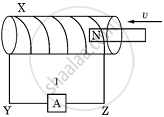
A permanent magnet is pushed at a constant speed v from the right into the pipe and it comes out at the left end of the pipe. During the entry and the exit of the magnet, the current in the wire YZ will be from:
Y to Z and then Y to Z
Z to Y and then Y to Z
Y to Z and then Z to Y
Z to Y and then Z to Y
Chapter:
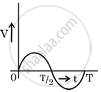
The alternating current I in an inductor is observed to vary with time t as shown in the graph for a cycle.
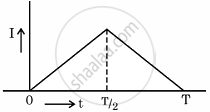
Which one of the following graphs is the correct representation of wave form of voltage V with time t?

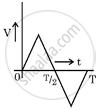
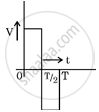
Chapter:
A transformer is connected to a 200 V ac source. The transformer supplies 3000 V to a device. If the number of turns in the primary coil is 450, then the number of turns in its secondary coil is ______.
30
450
4500
6750
Chapter:
Which one of the following statements is correct?
The electric field due to static charges is conservative, and field lines do not form closed loops.
The electric field due to static charges is conservative and field lines form closed loops.
The electric field due to static charges is non-conservative and field lines do not form closed loops.
The electric field due to static charges is non-conservative and field lines form closed loops.
Chapter:
A tub is filled with a transparent liquid to a height of 30.0 cm. The apparent depth of a coin lying at the bottom of the tub is found to be 16.0 cm. The speed of light in the liquid will be ______.
1.6 × 10⁸ m s−1
2.0 × 10⁸ m s−1
3.0 × 10⁸ m s−1
2.5 × 10⁸ m s−1
Chapter:
Atomic spectral emission lines of hydrogen atom are incident on a zinc surface. The lines which can emit photoelectrons from the surface are members of ______.
Balmer series
Paschen series
Lyman series
Neither Balmer, nor Paschen nor Lyman series
Chapter:
The energy of an electron in a hydrogen atom in ground state is −13.6 eV. Its energy in an orbit corresponding to quantum number n is −0.544 eV. The value of n is ______.
2
3
4
5
Chapter:
When the resistance measured between p and n ends of a p-n junction diode is high, it can act as a/an:
resistor
inductor
capacitor
switch
Chapter:
Assertion (A): In a semiconductor diode the thickness of depletion layer is not fixed.
Reason (R): Thickness of depletion layer in a semiconductor device depends upon many factors such as biasing of the semiconductor.
If both Assertion (A) and Reason (R) are true and Reason (R) is the correct explanation of Assertion (A).
If both Assertion (A) and Reason (R) are true but Reason (R) is not the correct explanation of Assertion (A).
If Assertion (A) is true but Reason (R) is false.
If both Assertion (A) and Reason (R) are false.
Chapter:
Assertion (A): In Bohr model of hydrogen atom, the angular momentum of an electron in nth orbit is proportional to the square root of its orbit radius rn.
Reason (R): According to Bohr model, electron can jump to its nearest orbits only.
If both Assertion (A) and Reason (R) are true and Reason (R) is the correct explanation of Assertion (A).
If both Assertion (A) and Reason (R) are true but Reason (R) is not the correct explanation of Assertion (A).
If Assertion (A) is true but Reason (R) is false.
If both Assertion (A) and Reason (R) are false.
Chapter:
Assertion (A): Out of infrared and radio waves, the radio waves show more diffraction effect.
Reason (R): Radio waves have greater frequency than infrared waves.
If both Assertion (A) and Reason (R) are true and Reason (R) is the correct explanation of Assertion (A).
If both Assertion (A) and Reason (R) are true but Reason (R) is not the correct explanation of Assertion (A).
If Assertion (A) is true but Reason (R) is false.
If both Assertion (A) and Reason (R) are false.
Chapter:
Assertion (A): In an ideal step-down transformer, the electrical energy is not lost.
Reason (R): In a step-down transformer, voltage decreases but the current increases.
If both Assertion (A) and Reason (R) are true and Reason (R) is the correct explanation of Assertion (A).
If both Assertion (A) and Reason (R) are true but Reason (R) is not the correct explanation of Assertion (A).
If Assertion (A) is true but Reason (R) is false.
If both Assertion (A) and Reason (R) are false.
Chapter:
Two wires of the same material and the same radius have their lengths in the ratio 2 : 3. They are connected in parallel to a battery which supplies a current of 15 A. Find the current through the wires.
Chapter:
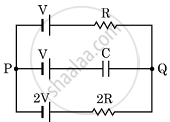
In the circuit three ideal cells of e.m.f. V, V and 2V are connected to a resistor of resistance R, a capacitor of capacitance C and another resistor of resistance 2R as shown in figure. In the steady state find:
- the potential difference between P and Q and
- potential difference across capacitor C.
Chapter:
In a double-slit experiment, 6th dark fringe is observed at a certain point of the screen. A transparent sheet of thickness t and refractive index n is now introduced in the path of one of the two interfering waves to increase its phase by `2pi (n - 1) t/lambda`. The pattern is shifted and 8th bright fringe is observed at the same point. Find the relation for thickness t in terms of n and λ.
Chapter:
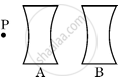
Two concave lenses A and B, each of focal length 8.0 cm are arranged coaxially 16 cm apart as shown in figure. An object P is placed at a distance of 4.0 cm from A. Find the position and nature of the final image formed.
Chapter:
A light of wavelength 400 nm is incident on metal surface whose work function is 3.0 × 10⁻¹⁹ J. Calculate the speed of the fastest photoelectrons emitted.
Chapter:
Advertisements
The threshold voltage of a silicon diode is 0.7 V. It is operated at this point by connecting the diode in series with a battery of V volt and a resistor of 1000 Ω. Find the value of V when the current drawn is 15 mA.
Chapter:
A cell of emf E and internal resistance r is connected with a variable external resistance R and a voltmeter showing potential drop V across R. Obtain the relationship between V, E, R and r.
Chapter:
Draw the shape of the graph showing the variation of terminal voltage V of the cell as a function of current I drawn from it. How one can determine the e.m.f. of the cell and its internal resistance from this graph?
Chapter:
In a region of a uniform electric field `vec E`, a negatively charged particle is moving with a constant velocity `vec v = -v_0 hat i` near a long straight conductor coinciding with XX' axis and carrying current I towards −X axis. The particle remains at a distance d from the conductor.
- Draw diagram showing direction of electric and magnetic fields.
- What are the various forces acting on the charged particle?
- Find the value of vo in terms of E, d and I.
Chapter:
Two infinitely long conductors kept along XX' and YY' axes are carrying current I1 and I2 along the −X axis and the −Y axis, respectively. Find the magnitude and direction of the net magnetic field produced at point P(X, Y).
Chapter:
State Lenz’s Law.
Chapter: [6] Electromagnetic Induction
In the given figure:
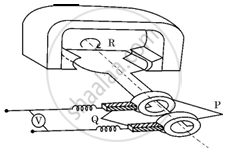
- Identify the machine.
- Name the parts P and Q and R of the machine.
- Give the polarities of the magnetic poles.
- Write the two ways of increasing the output voltage.
Chapter:
The electric field `vec E` of an electromagnetic wave propagating in north direction is oscillating in up and down direction. Describe the direction of magnetic field `vec B` of the wave.
Chapter:
Are the wave length of radio waves and microwaves longer or shorter than those detectable by human eyes?
Chapter:
Write the main uses of the following in human life:
Infrared waves
Chapter:
Write the main uses of the following in human life:
Gamma rays
Chapter:
When a parallel beam of light enters a water surface obliquely at some angle, what is the effect on the width of the beam?
Chapter:
With the help of a ray diagram, show that a straw appears bent when it is partly dipped in water and explain it.
Chapter:
Explain the transmission of optical signal through an optical fibre by a diagram.
Chapter:
Show the variation of binding energy per nucleon with mass number.
Chapter:
Write the significance of the binding energy curve.
Chapter:
Two nuclei with lower binding energy per nucleon form a nuclei with more binding energy per nucleon.
- What type of nuclear reaction is it?
- Whether the total mass of nuclei increases, decreases or remains unchanged?
- Does the process require energy or produce energy?
Chapter:
What are the majority and minority charge carriers in an extrinsic semiconductor?
Chapter:
A p-n junction is forward biased. Describe the movement of the charge carriers which produce current in it.
Chapter:
The graph shows the variation of current with voltage for a p-n junction diode.
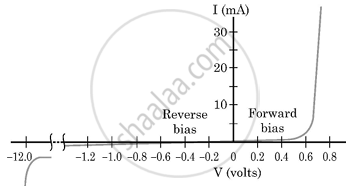
Estimate the dynamic resistance of diode at V = −0.6 volt.
Chapter:
Read the following paragraph and answer the questions that follow.
| A parallel plate capacitor has two parallel plates which are separated by an insulating medium like air, mica, etc. When the plates are connected to the terminals of a battery, they get equal and opposite charges and an electric field is set up in between them. This electric field between the two plates depends upon the potential difference applied, the separation of the plates and nature of the medium between the plates. |
(i) The electric field between the plates of a parallel plate capacitor is E. Now the separation between the plates is doubled and simultaneously the applied potential difference between the plates is reduced to half of its initial value. The new value of the electric field between the plates will be ______.
- E
- 2E
- `E/4`
- `E/2`
(ii) A constant electric field is to be maintained between the two plates of a capacitor whose separation d changes with time. Which of the graphs correctly depict the potential difference (V) to be applied between the plates as a function of separation between the plates (d) to maintain the constant electric field?


(iii)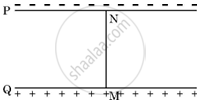
In the above figure P, Q are the two parallel plates of a capacitor. Plate Q is at positive potential with respect to plate P. MN is an imaginary line drawn perpendicular to the plates. Which of the graphs shows correctly the variations of the magnitude of electric field strength E along the line MN?


(iv) Three parallel plates are placed above each other with equal displacement `vec d` between neighbouring plates. The electric field between the first pair of the plates is `vec E_1` and the electric field between the second pair of the plates is `vec E_2`. The potential difference between the third and the first plate is ______.
- `(vec E_1 + vec E_2) * vec d`
- `(vec E_1 - vec E_2) * vec d`
- `(vec E_2 - vec E_1) * vec d`
- `(d(E_1 + E_2))/2`
OR
(iv) A material of dielectric constant K is filled in a parallel plate capacitor of capacitance C. The new value of its capacitance becomes ______.
- C
- `C/K`
- CK
- `C(1 + 1/K)`
Chapter:
Advertisements
Read the following paragraph and answer the questions that follow.
|
When a photon of suitable frequency is incident on a metal surface, photoelectron is emitted from it. If the frequency is below a threshold frequency (vo) for the surface, no photoelectron is emitted. For a photon of frequency v(v > vo), the kinetic energy of the emitted photoelectrons is h(v − vo). The photocurrent can be stopped by applying a potential Vo called ‘stopping potential’ on the anode. Thus maximum kinetic energy of photoelectrons Km = eVo = h(v − vo). The experimental graph between Vo and v for a metal is shown in figure. This is a straight line of slope m.
|
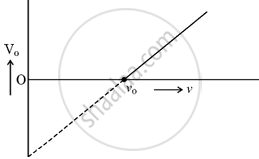
(i) The straight line graphs obtained for two metals ______.
- coincide each other.
- are parallel to each other.
- are not parallel to each other and cross at a point on v-axis.
- are not parallel to each other and do not cross at a point on v-axis.
(ii) The value of Planck’s constant for this metal is ______.
- `e/m`
- `1/(me)`
- me
- `m/e`
(iii) The intercepts on v-axis and Vo-axis of the graph are respectively ______.
- vo, `(hv_o)/e`
- vo, hvo
- `(hv_o)/e`, vo
- hvo, vo
OR
(iii) When the wavelength of a photon is doubled, how many times its wave number and frequency become, respectively?
- 2, `1/2`
- `1/2, 1/2`
- `1/2`, 2
- 2, 2
(iv) The momentum of a photon is 5.0 × 10⁻²⁹ kg. m/s. Ignoring relativistic effects (if any), the wavelength of the photon is ______.
- 1.33 μm
- 3.3 μm
- 16.6 μm
- 13.3 μm
Chapter:
A small conducting sphere A of radius r charged to a potential V, is enclosed by a spherical conducting shell B of radius R. If A and B are connected by a thin wire, calculate the final potential on sphere A and shell B.
Chapter:
Write two important characteristics of equipotential surfaces.
Chapter: [2] Electrostatic Potential and Capacitance
A uniform electric field of 50 NC−1 is set up in a region along +x axis. If the potential at the origin (0, 0) is 220 V, find the potential at a point (4m, 3m).
Chapter:
What is the difference between an open surface and a closed surface?
Chapter:
Draw elementary surface vector `d vec S` for a spherical surface S.
Chapter:
A charge outside a Gaussian surface does not contribute to total electric flux through the surface. Why?
Chapter:
A small spherical shell S1 has point charges q1 = −3 μC, q2 = −2 μC and q3 = 9 μC inside it. This shell is enclosed by another big spherical shell S2. A point charge Q is placed in between the two surfaces S1 and S2. If the electric flux through the surface S2 is four times the flux through surface S1, find charge Q.
Chapter:
What is the source of force acting on a current-carrying conductor placed in a magnetic field? Obtain the expression for force acting between two long straight parallel conductors carrying steady currents and hence define ‘ampere’.
Chapter:
A point charge q is moving with velocity `vec v` in a uniform magnetic field `vec B`. Find the work done by the magnetic force on the charge.
Chapter:
Explain the necessary conditions in which the trajectory of a charged particle is helical in a uniform magnetic field.
Chapter:
A current carrying loop can be considered as a magnetic dipole placed along its axis. Explain.
Chapter:
Obtain the relation for magnetic dipole moment `vec M` of current carrying coil. Give the direction of `vec M`.
Chapter:
A current carrying coil is placed in an external uniform magnetic field. The coil is free to turn in the magnetic field. What is the net force acting on the coil? Obtain the orientation of the coil in stable equilibrium. Show that in this orientation the flux of the total field (field produced by the loop + external field) through the coil is maximum.
Chapter:
A thin pencil of length `(f/4)` is placed coinciding with the principal axis of a mirror of focal length f. The image of the pencil is real and enlarged, just touches the pencil. Calculate the magnification produced by the mirror.
Chapter:
A ray of light is incident on a refracting face AB of a prism ABC at an angle of 45°. The ray emerges from face AC and the angle of deviation is 15°. The angle of prism is 30°. Show that the emergent ray is normal to the face AC from which it emerges out. Find the refraction index of the material of the prism.
Chapter:
Light consisting of two wavelengths 600 nm and 480 nm is used to obtain interference fringes in a double slit experiment. The screen is placed 1.0 m away from slits which are 1.0 nm apart.
- Calculate the distance of the third bright fringe on the screen from the central maximum for wavelength 600 nm.
- Find the least distance from the central maximum where the bright fringes due to both the wavelengths coincide.
Chapter:
Draw the variation of intensity with angle of diffraction in single slit diffraction pattern.
Chapter:
Write the expression for value of angle corresponding to zero intensity locations.
Chapter:
In what way diffraction of light waves differs from diffraction of sound waves?
Chapter:
Other Solutions
Submit Question Paper
Help us maintain new question papers on Shaalaa.com, so we can continue to help studentsonly jpg, png and pdf files
CBSE previous year question papers Class 12 Physics with solutions 2024 - 2025
Previous year Question paper for CBSE Class 12 Physics-2025 is solved by experts. Solved question papers gives you the chance to check yourself after your mock test.
By referring the question paper Solutions for Physics, you can scale your preparation level and work on your weak areas. It will also help the candidates in developing the time-management skills. Practice makes perfect, and there is no better way to practice than to attempt previous year question paper solutions of CBSE Class 12.
How CBSE Class 12 Question Paper solutions Help Students ?
• Question paper solutions for Physics will helps students to prepare for exam.
• Question paper with answer will boost students confidence in exam time and also give you an idea About the important questions and topics to be prepared for the board exam.
• For finding solution of question papers no need to refer so multiple sources like textbook or guides.
