Advertisements
Advertisements
प्रश्न
What is the source of force acting on a current-carrying conductor placed in a magnetic field? Obtain the expression for force acting between two long straight parallel conductors carrying steady currents and hence define ‘ampere’.
Advertisements
उत्तर
Force between two long, straight, parallel conductors carrying current in the same direction:
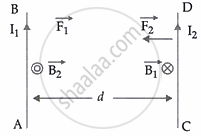
Two wires AB and CD carry currents I1 and I2, respectively, in the same direction.
The distance between them is d.
Due to I1 current in AB,
Magnetic field at any point on CD is B1 = `mu_0/(4 pi) xx (2 I_1)/d`
Force on unit length of CD is F1 = `(BIL)/L` = B1 × I2 × 1
= `mu_0/(4 pi) xx (2 I_1 I_2)/d`, acting towards AB ...[Applying Fleming’s left-hand rule]
Similarly, due to I2 current in CD,
Magnetic field at any point on AB is B2 = `mu_0/(4 pi) xx (2 I_2)/d`
Force on unit length of AB is F2 = `(BIL)/L` = B2 × I1 × 1
= `mu_0/(4 pi) xx (2 I_1 I_2)/d` acting towards CD ...[Applying Fleming’s left-hand rule]
So, the magnitudes of F1 and F2 are the same and oppositely directed. So, the forces are attractive.
Definition of 1 ampere:
If I1 = I2 ampere and d = 1 m,
Then, F = `mu_0/(4 pi) xx (2 I_1 I_2)/d`
= 2 × 10⁻⁷ N
So, 1 Ampere may be defined as the amount of steady current which, when maintained in each of the two very long, straight, parallel conductors of negligible cross-section, and placed one metre apart in a vacuum, would exert on each of these conductors a force equal to 2 × 10⁻⁷ N per metre of length.
