Advertisements
Advertisements
प्रश्न
Write two important characteristics of equipotential surfaces.
Advertisements
उत्तर १
- Perpendicular to the Electric Field: At all times, equipotential surfaces are perpendicular to the direction of the electric field.
- No Work Done in Moving a Charge: Moving a charge along an equipotential surface requires no effort because the potential is constant throughout.
उत्तर २
- Potential remains the same at all the points on the equipotential surface.
- No work is required to move a charge within an equipotential surface.
APPEARS IN
संबंधित प्रश्न
Two charges 2 μC and −2 µC are placed at points A and B 6 cm apart.
- Identify an equipotential surface of the system.
- What is the direction of the electric field at every point on this surface?
The discharging current in the atmosphere due to the small conductivity of air is known to be 1800 A on an average over the globe. Why then does the atmosphere not discharge itself completely in due course and become electrically neutral? In other words, what keeps the atmosphere charged?
What is the geometrical shape of equipotential surfaces due to a single isolated charge?
The diagrams below show regions of equipotentials.
(i)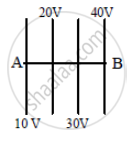 |
(ii) |
(iii)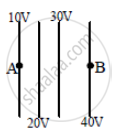 |
(iv)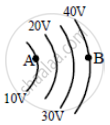 |
A positive charge is moved from A to B in each diagram.
Equipotential surfaces ______.
Find the equation of the equipotentials for an infinite cylinder of radius r0, carrying charge of linear density λ.
Equipotential surfaces are shown in figure. Then the electric field strength will be ______.
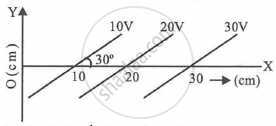
What is meant by an equipotential surface?
For an electric dipole (+q, −q), the equipotential surfaces are best described as:
A point charge of \[1\ \mu\text{C}\] produces a potential \[V = \frac{kq}{r}\]. At what distance from the charge does the potential equal 90 V? (Take \[k = 9 \times 10^9\ \text{N m}^2/\text{C}^2\])
