Advertisements
Advertisements
Question
Write two important characteristics of equipotential surfaces.
Advertisements
Solution 1
- Perpendicular to the Electric Field: At all times, equipotential surfaces are perpendicular to the direction of the electric field.
- No Work Done in Moving a Charge: Moving a charge along an equipotential surface requires no effort because the potential is constant throughout.
Solution 2
- Potential remains the same at all the points on the equipotential surface.
- No work is required to move a charge within an equipotential surface.
APPEARS IN
RELATED QUESTIONS
The top of the atmosphere is at about 400 kV with respect to the surface of the earth, corresponding to an electric field that decreases with altitude. Near the surface of the earth, the field is about 100 Vm−1. Why then do we not get an electric shock as we step out of our house into the open? (Assume the house to be a steel cage so there is no field inside!)
The discharging current in the atmosphere due to the small conductivity of air is known to be 1800 A on an average over the globe. Why then does the atmosphere not discharge itself completely in due course and become electrically neutral? In other words, what keeps the atmosphere charged?
Draw the equipotential surfaces due to an electric dipole. Locate the points where the potential due to the dipole is zero.
Depict the equipotential surface due to
(i) an electric dipole,
(ii) two identical positive charges separated by a distance.
Find the amount of work done in rotating an electric dipole of dipole moment 3.2 x 10- 8Cm from its position of stable equilibrium to the position of unstable equilibrium in a uniform electric field if intensity 104 N/C.
A particle of mass 'm' having charge 'q' is held at rest in uniform electric field of intensity 'E'. When it is released, the kinetic energy attained by it after covering a distance 'y' will be ______.
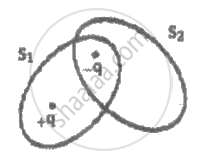
S1 and S2 are the two imaginary surfaces enclosing the charges +q and -q as shown. The electric flux through S1 and S2 are respectively ______.
- The potential at all the points on an equipotential surface is same.
- Equipotential surfaces never intersect each other.
- Work done in moving a charge from one point to other on an equipotential surface is zero.
Can two equipotential surfaces intersect each other?
Prove that a closed equipotential surface with no charge within itself must enclose an equipotential volume.
