Advertisements
Advertisements
Question
Prove that a closed equipotential surface with no charge within itself must enclose an equipotential volume.
Advertisements
Solution
Let us assume that in a closed equipotential surface with no charge the potential is changing from position to position. Let the potential just inside the surface is different to that of the surface causing a potential gradient (dV/dr)
It means E ≠ 0 electric field comes into existence, which is given by as E = – dV/dr
It means there will be field lines pointing inwards or outwards from the surface. These lines cannot be again on the surface, as the surface is equipotential. It is possible only when the other end of the field lines originated from the charges inside. This contradicts the original assumption. Hence, the entire volume inside must be equipotential.
APPEARS IN
RELATED QUESTIONS
Describe schematically the equipotential surfaces corresponding to
(a) a constant electric field in the z-direction,
(b) a field that uniformly increases in magnitude but remains in a constant (say, z) direction,
(c) a single positive charge at the origin, and
(d) a uniform grid consisting of long equally spaced parallel charged wires in a plane.
What is the geometrical shape of equipotential surfaces due to a single isolated charge?
Depict the equipotential surfaces for a system of two identical positive point charges placed a distance(d) apart?
Two identical point charges, q each, are kept 2m apart in the air. A third point charge Q of unknown magnitude and sign is placed on the line joining the charges such that the system remains in equilibrium. Find the position and nature of Q.
Draw the equipotential surfaces due to an electric dipole.
Write two important characteristics of equipotential surfaces.
Statement - 1: For practical purpose, the earth is used as a reference at zero potential in electrical circuits.
Statement - 2: The electrical potential of a sphere of radius R with charge Q uniformly distributed on the surface is given by `Q/(4piepsilon_0R)`.
Assertion: Electric field is discontinuous across the surface of a spherical charged shell.
Reason: Electric potential is continuous across the surface of a spherical charged shell.
Consider the following statements and select the correct statement(s).
- Electric field lines are always perpendicular to equipotential surface.
- No two equipotential surfaces can intersect each other.
- Electric field lines are in the direction of tangent to an equipotential surface.
Equipotentials at a great distance from a collection of charges whose total sum is not zero are approximately.
Can two equipotential surfaces intersect each other?
Equipotential surfaces ______.
- are closer in regions of large electric fields compared to regions of lower electric fields.
- will be more crowded near sharp edges of a conductor.
- will be more crowded near regions of large charge densities.
- will always be equally spaced.
Equipotential surfaces are shown in figure. Then the electric field strength will be ______.
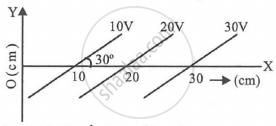
What is an equipotential surface?
Equipotential surfaces are denser (closer together) in regions where:
For an electric dipole (+q, −q), the equipotential surfaces are best described as:
A particle floats between two parallel plates separated by 0.1 m with a potential difference of 4000 V. The particle carries a charge of \[1.6 \times 10^{-19}\] C. Taking \[g = 9.8\ \text{m/s}^2\], the mass of the particle is approximately:
