Advertisements
Advertisements
Question
What is the geometrical shape of equipotential surfaces due to a single isolated charge?
Advertisements
Solution
For an isolated charge the equipotential surfaces are co-centric spherical shells and the distance between the shells increases with the decrease in electric field.
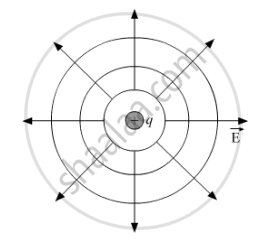
APPEARS IN
RELATED QUESTIONS
Define an equipotential surface.
Depict the equipotential surfaces for a system of two identical positive point charges placed a distance(d) apart?
Assertion: Electric field is discontinuous across the surface of a spherical charged shell.
Reason: Electric potential is continuous across the surface of a spherical charged shell.
Which of the following is NOT the property of equipotential surface?
Equipotential surfaces ______.
- are closer in regions of large electric fields compared to regions of lower electric fields.
- will be more crowded near sharp edges of a conductor.
- will be more crowded near regions of large charge densities.
- will always be equally spaced.
Find the equation of the equipotentials for an infinite cylinder of radius r0, carrying charge of linear density λ.
What is an equipotential surface?
A charge \[q_0\] is moved from point A to point B on the same equipotential surface. If the potentials at A and B are \[V_A\] and \[V_B\] respectively, the work done is:
A particle floats between two parallel plates separated by 0.1 m with a potential difference of 4000 V. The particle carries a charge of \[1.6 \times 10^{-19}\] C. Taking \[g = 9.8\ \text{m/s}^2\], the mass of the particle is approximately:
