Advertisements
Advertisements
Question
Consider a uniform electric field in the ẑ direction. The potential is a constant ______.
- in all space.
- for any x for a given z.
- for any y for a given z.
- on the x-y plane for a given z.
Options
a, b and c
a, c and d
b, c and d
c and d
Advertisements
Solution
b, c and d
Explanation:
We know, the electric field intensity E and electric potential V are E = `- (dV)/(dr)`
Electric potential decreases in the direction of the electric field. The direction of electric field is always perpendicular to one equipotential surface maintained at the high electrostatic potential to another equipotential surface maintained at low electrostatic potential.
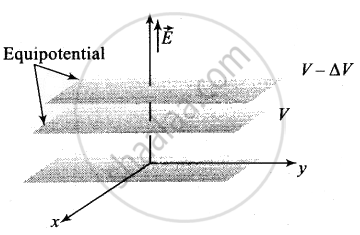
The electric field in the z-direction suggests that equipotential surfaces are in the x-y plane. Therefore the potential is a constant for any x for a given z, for any y for a given z and on the x-y plane for a given z.
APPEARS IN
RELATED QUESTIONS
A regular hexagon of side 10 cm has a charge 5 µC at each of its vertices. Calculate the potential at the centre of the hexagon.
What are the forms of energy into which the electrical energy of the atmosphere is dissipated during a lightning?
(Hint: The earth has an electric field of about 100 Vm−1 at its surface in the downward direction, corresponding to a surface charge density = −10−9 C m−2. Due to the slight conductivity of the atmosphere up to about 50 km (beyond which it is good conductor), about + 1800 C is pumped every second into the earth as a whole. The earth, however, does not get discharged since thunderstorms and lightning occurring continually all over the globe pump an equal amount of negative charge on the earth.)
What is the geometrical shape of equipotential surfaces due to a single isolated charge?
Draw the equipotential surfaces due to an electric dipole. Locate the points where the potential due to the dipole is zero.
Why is there no work done in moving a charge from one point to another on an equipotential surface?
Two identical point charges, q each, are kept 2m apart in the air. A third point charge Q of unknown magnitude and sign is placed on the line joining the charges such that the system remains in equilibrium. Find the position and nature of Q.
A particle of mass 'm' having charge 'q' is held at rest in uniform electric field of intensity 'E'. When it is released, the kinetic energy attained by it after covering a distance 'y' will be ______.
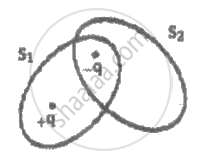
S1 and S2 are the two imaginary surfaces enclosing the charges +q and -q as shown. The electric flux through S1 and S2 are respectively ______.
Consider the following statements and select the correct statement(s).
- Electric field lines are always perpendicular to equipotential surface.
- No two equipotential surfaces can intersect each other.
- Electric field lines are in the direction of tangent to an equipotential surface.
Equipotential surfaces ______.
Which of the following is NOT the property of equipotential surface?
Can two equipotential surfaces intersect each other?
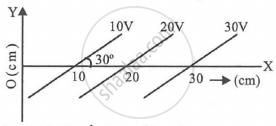
Equipotential surfaces are shown in figure. Then the electric field strength will be ______.
A curve connecting points that all have equal electric potential is best described as:
A charge \[q_0\] is moved from point A to point B on the same equipotential surface. If the potentials at A and B are \[V_A\] and \[V_B\] respectively, the work done is:
A particle floats between two parallel plates separated by 0.1 m with a potential difference of 4000 V. The particle carries a charge of \[1.6 \times 10^{-19}\] C. Taking \[g = 9.8\ \text{m/s}^2\], the mass of the particle is approximately:
