Advertisements
Advertisements
प्रश्न
Consider a uniform electric field in the ẑ direction. The potential is a constant ______.
- in all space.
- for any x for a given z.
- for any y for a given z.
- on the x-y plane for a given z.
पर्याय
a, b and c
a, c and d
b, c and d
c and d
Advertisements
उत्तर
b, c and d
Explanation:
We know, the electric field intensity E and electric potential V are E = `- (dV)/(dr)`
Electric potential decreases in the direction of the electric field. The direction of electric field is always perpendicular to one equipotential surface maintained at the high electrostatic potential to another equipotential surface maintained at low electrostatic potential.
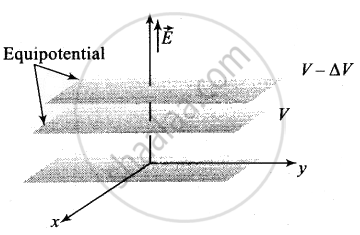
The electric field in the z-direction suggests that equipotential surfaces are in the x-y plane. Therefore the potential is a constant for any x for a given z, for any y for a given z and on the x-y plane for a given z.
APPEARS IN
संबंधित प्रश्न
Describe schematically the equipotential surfaces corresponding to
(a) a constant electric field in the z-direction,
(b) a field that uniformly increases in magnitude but remains in a constant (say, z) direction,
(c) a single positive charge at the origin, and
(d) a uniform grid consisting of long equally spaced parallel charged wires in a plane.
The discharging current in the atmosphere due to the small conductivity of air is known to be 1800 A on an average over the globe. Why then does the atmosphere not discharge itself completely in due course and become electrically neutral? In other words, what keeps the atmosphere charged?
What is the geometrical shape of equipotential surfaces due to a single isolated charge?
Draw the equipotential surfaces due to an electric dipole. Locate the points where the potential due to the dipole is zero.
Two identical point charges, q each, are kept 2m apart in the air. A third point charge Q of unknown magnitude and sign is placed on the line joining the charges such that the system remains in equilibrium. Find the position and nature of Q.
Depict the equipotential surface due to
(i) an electric dipole,
(ii) two identical positive charges separated by a distance.
Write two important characteristics of equipotential surfaces.
A particle of mass 'm' having charge 'q' is held at rest in uniform electric field of intensity 'E'. When it is released, the kinetic energy attained by it after covering a distance 'y' will be ______.
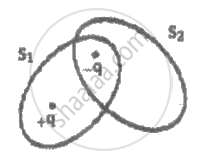
S1 and S2 are the two imaginary surfaces enclosing the charges +q and -q as shown. The electric flux through S1 and S2 are respectively ______.
The diagrams below show regions of equipotentials.
(i)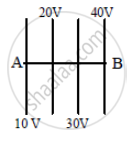 |
(ii)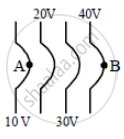 |
(iii)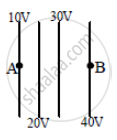 |
(iv)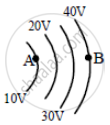 |
A positive charge is moved from A to B in each diagram.
- The potential at all the points on an equipotential surface is same.
- Equipotential surfaces never intersect each other.
- Work done in moving a charge from one point to other on an equipotential surface is zero.
Can two equipotential surfaces intersect each other?
The work done to move a charge along an equipotential from A to B ______.
- cannot be defined as `- int_A^B E.dl`
- must be defined as `- int_A^B E.dl`
- is zero.
- can have a non-zero value.
In the hierarchy of equipotential concepts, which term describes a volume enclosed at the same potential?
If the electric field \[\vec{E}\] had a component along (tangent to) an equipotential surface, what contradiction would arise?
What is the shape of the equipotential surfaces for a single point charge (+q)?
In the derivation proving \[\vec{E}\] is perpendicular to an equipotential surface, a charge \[q_0\] undergoes a small displacement \[d\vec{l}\] along the surface, with \[\vec{E}\] making an angle \[\theta\] with the displacement. Equating the work expressions leads to which conclusion?
The relation between the electric field \[\vec{E}\] and the potential gradient is expressed as:
A particle floats between two parallel plates separated by 0.1 m with a potential difference of 4000 V. The particle carries a charge of \[1.6 \times 10^{-19}\] C. Taking \[g = 9.8\ \text{m/s}^2\], the mass of the particle is approximately:
A point charge of \[1\ \mu\text{C}\] produces a potential \[V = \frac{kq}{r}\]. At what distance from the charge does the potential equal 90 V? (Take \[k = 9 \times 10^9\ \text{N m}^2/\text{C}^2\])
