Advertisements
Advertisements
प्रश्न
What is meant by an equipotential surface?
Advertisements
उत्तर
The surface of locus of all points at the same potential.
APPEARS IN
संबंधित प्रश्न
A regular hexagon of side 10 cm has a charge 5 µC at each of its vertices. Calculate the potential at the centre of the hexagon.
Write two important characteristics of equipotential surfaces.
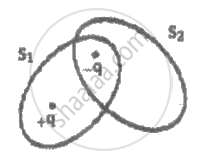
S1 and S2 are the two imaginary surfaces enclosing the charges +q and -q as shown. The electric flux through S1 and S2 are respectively ______.
Assertion: Electric field is discontinuous across the surface of a spherical charged shell.
Reason: Electric potential is continuous across the surface of a spherical charged shell.
Equipotential surfaces ______.
- are closer in regions of large electric fields compared to regions of lower electric fields.
- will be more crowded near sharp edges of a conductor.
- will be more crowded near regions of large charge densities.
- will always be equally spaced.
The work done to move a charge along an equipotential from A to B ______.
- cannot be defined as `- int_A^B E.dl`
- must be defined as `- int_A^B E.dl`
- is zero.
- can have a non-zero value.
Prove that a closed equipotential surface with no charge within itself must enclose an equipotential volume.
A curve connecting points that all have equal electric potential is best described as:
The direction in which electric potential decreases is:
For an infinite line charge (infinite cylinder configuration), the equipotential surfaces are:
