Advertisements
Advertisements
प्रश्न
Equipotentials at a great distance from a collection of charges whose total sum is not zero are approximately.
पर्याय
spheres
planes
paraboloids
ellipsoids
Advertisements
उत्तर
spheres
Explanation:
The collection of charges, whose total sum is not zero, with regard to great distance can be considered as a single-point charge. The equipotential surfaces due to a point charge are spherical.
Important point:
- The electric potential due to point charge q is given by V = q/4πε0r
- It means electric potential due to point charge is same for all equidistant points. The locus of these equidistant points, which are at the same potential, form spherical surface.
APPEARS IN
संबंधित प्रश्न
Define an equipotential surface.
Draw a sketch of equipotential surfaces due to a single charge (-q), depicting the electric field lines due to the charge
Describe schematically the equipotential surfaces corresponding to
(a) a constant electric field in the z-direction,
(b) a field that uniformly increases in magnitude but remains in a constant (say, z) direction,
(c) a single positive charge at the origin, and
(d) a uniform grid consisting of long equally spaced parallel charged wires in a plane.
A man fixes outside his house one evening a two metre high insulating slab carrying on its top a large aluminium sheet of area 1 m2. Will he get an electric shock if he touches the metal sheet next morning?
Draw equipotential surfaces:
(1) in the case of a single point charge and
(2) in a constant electric field in Z-direction. Why are the equipotential surfaces about a single charge not equidistant?
(3) Can electric field exist tangential to an equipotential surface? Give reason
What is the geometrical shape of equipotential surfaces due to a single isolated charge?
A particle of mass 'm' having charge 'q' is held at rest in uniform electric field of intensity 'E'. When it is released, the kinetic energy attained by it after covering a distance 'y' will be ______.
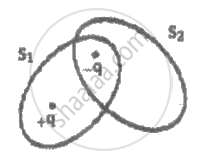
S1 and S2 are the two imaginary surfaces enclosing the charges +q and -q as shown. The electric flux through S1 and S2 are respectively ______.
Consider the following statements and select the correct statement(s).
- Electric field lines are always perpendicular to equipotential surface.
- No two equipotential surfaces can intersect each other.
- Electric field lines are in the direction of tangent to an equipotential surface.
Which of the following is NOT the property of equipotential surface?
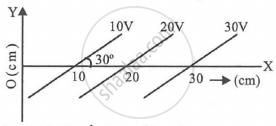
Equipotential surfaces are shown in figure. Then the electric field strength will be ______.
In the hierarchy of equipotential concepts, which term describes a volume enclosed at the same potential?
Equipotential surfaces are denser (closer together) in regions where:
The surface of any conductor in electrostatic equilibrium is an equipotential surface because:
What is the shape of the equipotential surfaces for a single point charge (+q)?
