Advertisements
Advertisements
प्रश्न
Two charges 2 μC and −2 µC are placed at points A and B 6 cm apart.
- Identify an equipotential surface of the system.
- What is the direction of the electric field at every point on this surface?
Advertisements
उत्तर
Given: q1 = 2 μC = 2 × 10⁻⁶ C
q2 = −2 µC = 2 × 10⁻⁶ C
r = 6 cm = 0.06 m
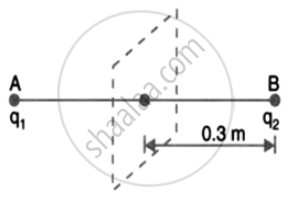
(a) Potential will be zero due to both charges at the equipotential surface.
`1/(4piε_0)[q_1/x + q_2/((0.06 - x))] = 0`
`q_1/x = -q_2/((0.06 - x))`
`(2 xx 10^-6)/x = -((-2 xx 10^-6))/([(0.06) - x])`
x = 0.06 − x
x + x = 0.06
2x = 0.06
`x = 0.06/2`
x = 0.03 m
i.e., the plane normal to AB and passing through its mid-point has zero potential everywhere.
(b) The direction of the electric field at every point on this surface is normal to the plane in the direction of AB.
संबंधित प्रश्न
Draw a sketch of equipotential surfaces due to a single charge (-q), depicting the electric field lines due to the charge
Depict the equipotential surfaces for a system of two identical positive point charges placed a distance(d) apart?
Draw the equipotential surfaces due to an electric dipole.
Depict the equipotential surface due to
(i) an electric dipole,
(ii) two identical positive charges separated by a distance.
Write two important characteristics of equipotential surfaces.
Statement - 1: For practical purpose, the earth is used as a reference at zero potential in electrical circuits.
Statement - 2: The electrical potential of a sphere of radius R with charge Q uniformly distributed on the surface is given by `Q/(4piepsilon_0R)`.
Consider the following statements and select the correct statement(s).
- Electric field lines are always perpendicular to equipotential surface.
- No two equipotential surfaces can intersect each other.
- Electric field lines are in the direction of tangent to an equipotential surface.
Which of the following is NOT the property of equipotential surface?
The work done to move a charge along an equipotential from A to B ______.
- cannot be defined as `- int_A^B E.dl`
- must be defined as `- int_A^B E.dl`
- is zero.
- can have a non-zero value.
Prove that a closed equipotential surface with no charge within itself must enclose an equipotential volume.
Equipotential surfaces are denser (closer together) in regions where:
The direction in which electric potential decreases is:
The surface of any conductor in electrostatic equilibrium is an equipotential surface because:
What is the shape of the equipotential surfaces for a single point charge (+q)?
In a uniform electric field, the equipotential surfaces take the shape of:
In the derivation proving \[\vec{E}\] is perpendicular to an equipotential surface, a charge \[q_0\] undergoes a small displacement \[d\vec{l}\] along the surface, with \[\vec{E}\] making an angle \[\theta\] with the displacement. Equating the work expressions leads to which conclusion?
A point charge of \[1\ \mu\text{C}\] produces a potential \[V = \frac{kq}{r}\]. At what distance from the charge does the potential equal 90 V? (Take \[k = 9 \times 10^9\ \text{N m}^2/\text{C}^2\])
