Advertisements
Advertisements
प्रश्न
Two charges 2 μC and −2 µC are placed at points A and B 6 cm apart.
- Identify an equipotential surface of the system.
- What is the direction of the electric field at every point on this surface?
Advertisements
उत्तर
Given: q1 = 2 μC = 2 × 10⁻⁶ C
q2 = −2 µC = 2 × 10⁻⁶ C
r = 6 cm = 0.06 m
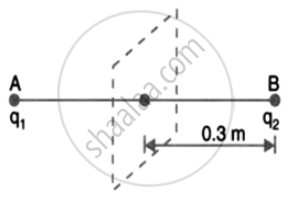
(a) Potential will be zero due to both charges at the equipotential surface.
`1/(4piε_0)[q_1/x + q_2/((0.06 - x))] = 0`
`q_1/x = -q_2/((0.06 - x))`
`(2 xx 10^-6)/x = -((-2 xx 10^-6))/([(0.06) - x])`
x = 0.06 − x
x + x = 0.06
2x = 0.06
`x = 0.06/2`
x = 0.03 m
i.e., the plane normal to AB and passing through its mid-point has zero potential everywhere.
(b) The direction of the electric field at every point on this surface is normal to the plane in the direction of AB.
संबंधित प्रश्न
A regular hexagon of side 10 cm has a charge 5 µC at each of its vertices. Calculate the potential at the centre of the hexagon.
Describe schematically the equipotential surfaces corresponding to
(a) a constant electric field in the z-direction,
(b) a field that uniformly increases in magnitude but remains in a constant (say, z) direction,
(c) a single positive charge at the origin, and
(d) a uniform grid consisting of long equally spaced parallel charged wires in a plane.
The top of the atmosphere is at about 400 kV with respect to the surface of the earth, corresponding to an electric field that decreases with altitude. Near the surface of the earth, the field is about 100 Vm−1. Why then do we not get an electric shock as we step out of our house into the open? (Assume the house to be a steel cage so there is no field inside!)
Draw equipotential surfaces:
(1) in the case of a single point charge and
(2) in a constant electric field in Z-direction. Why are the equipotential surfaces about a single charge not equidistant?
(3) Can electric field exist tangential to an equipotential surface? Give reason
Draw the equipotential surfaces due to an electric dipole.
Depict the equipotential surface due to
(i) an electric dipole,
(ii) two identical positive charges separated by a distance.
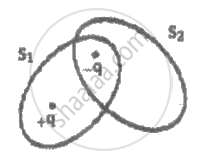
S1 and S2 are the two imaginary surfaces enclosing the charges +q and -q as shown. The electric flux through S1 and S2 are respectively ______.
- The potential at all the points on an equipotential surface is same.
- Equipotential surfaces never intersect each other.
- Work done in moving a charge from one point to other on an equipotential surface is zero.
Can two equipotential surfaces intersect each other?
Consider a uniform electric field in the ẑ direction. The potential is a constant ______.
- in all space.
- for any x for a given z.
- for any y for a given z.
- on the x-y plane for a given z.
The work done to move a charge along an equipotential from A to B ______.
- cannot be defined as `- int_A^B E.dl`
- must be defined as `- int_A^B E.dl`
- is zero.
- can have a non-zero value.
Find the equation of the equipotentials for an infinite cylinder of radius r0, carrying charge of linear density λ.
What is an equipotential surface?
A curve connecting points that all have equal electric potential is best described as:
If the electric field \[\vec{E}\] had a component along (tangent to) an equipotential surface, what contradiction would arise?
The direction in which electric potential decreases is:
For an infinite line charge (infinite cylinder configuration), the equipotential surfaces are:
