Advertisements
Advertisements
प्रश्न
Equipotential surfaces ______.
- are closer in regions of large electric fields compared to regions of lower electric fields.
- will be more crowded near sharp edges of a conductor.
- will be more crowded near regions of large charge densities.
- will always be equally spaced.
विकल्प
a, b and c
a, c and d
b, c and d
c and d
Advertisements
उत्तर
a, b and c
Explanation:
The density of the equipotential lines gives an idea about the magnitude of electric field. Higher the density, larger the field strength.
We know, the electric field intensity E and electric potential V are related as a, b and c
We know that on any two points of equipotential surface, potential difference is zero or of equal potential.
∵ `E = (-dV)/(dr)`
So the electric field intensity is inversely proportional to the separation between equipotential surfaces.
So equipotential surfaces are closer in regions of large electric. Thus, it verifies answer a
The electric field is larger near the sharp edge, due to larger charge density as a is very small
∵ `sigma = q/A`
So equipotential surfaces are closer or crowded. It verifies answer b.
As the electric field `E = (kq)/r^2` and potential or field decreases as size of the body increases or vice-versa (case of the earth), so the equipotential surfaces will be more crowded if the charge density `sigma = q/A` increases. It verifies the answer c.
As the equipotential surface depends on distance r by `E = (-dV)/r` and `V = (kq)/r`. Equipotential surface depends on charge density at that place which is different at a different place, so equipotential surface are not equispaced all over.
Hence the electric field intensity E is inversely proportional to the separation between equipotential surfaces. So, equipotential surfaces are closer in regions of large electric fields. As electric field intensities is large near sharp edges of charged conductor and near regions of large charge densities. Therefore, equipotential surfaces are closer at such places.
APPEARS IN
संबंधित प्रश्न
Draw a sketch of equipotential surfaces due to a single charge (-q), depicting the electric field lines due to the charge
A regular hexagon of side 10 cm has a charge 5 µC at each of its vertices. Calculate the potential at the centre of the hexagon.
The discharging current in the atmosphere due to the small conductivity of air is known to be 1800 A on an average over the globe. Why then does the atmosphere not discharge itself completely in due course and become electrically neutral? In other words, what keeps the atmosphere charged?
What is the geometrical shape of equipotential surfaces due to a single isolated charge?
Draw the equipotential surfaces due to an electric dipole. Locate the points where the potential due to the dipole is zero.
Why is there no work done in moving a charge from one point to another on an equipotential surface?
Depict the equipotential surfaces for a system of two identical positive point charges placed a distance(d) apart?
Find the amount of work done in rotating an electric dipole of dipole moment 3.2 x 10- 8Cm from its position of stable equilibrium to the position of unstable equilibrium in a uniform electric field if intensity 104 N/C.
Statement - 1: For practical purpose, the earth is used as a reference at zero potential in electrical circuits.
Statement - 2: The electrical potential of a sphere of radius R with charge Q uniformly distributed on the surface is given by `Q/(4piepsilon_0R)`.
S1 and S2 are the two imaginary surfaces enclosing the charges +q and -q as shown. The electric flux through S1 and S2 are respectively ______.
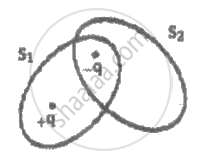
Consider the following statements and select the correct statement(s).
- Electric field lines are always perpendicular to equipotential surface.
- No two equipotential surfaces can intersect each other.
- Electric field lines are in the direction of tangent to an equipotential surface.
Which of the following is NOT the property of equipotential surface?
Consider a uniform electric field in the ẑ direction. The potential is a constant ______.
- in all space.
- for any x for a given z.
- for any y for a given z.
- on the x-y plane for a given z.
If the electric field \[\vec{E}\] had a component along (tangent to) an equipotential surface, what contradiction would arise?
Equipotential surfaces are denser (closer together) in regions where:
The surface of any conductor in electrostatic equilibrium is an equipotential surface because:
The relation between the electric field \[\vec{E}\] and the potential gradient is expressed as:
A point charge of \[1\ \mu\text{C}\] produces a potential \[V = \frac{kq}{r}\]. At what distance from the charge does the potential equal 90 V? (Take \[k = 9 \times 10^9\ \text{N m}^2/\text{C}^2\])
