Advertisements
Advertisements
प्रश्न
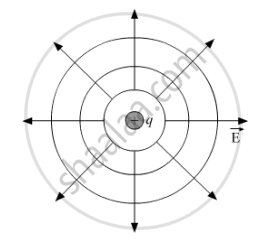
What is the geometrical shape of equipotential surfaces due to a single isolated charge?
Advertisements
उत्तर
For an isolated charge the equipotential surfaces are co-centric spherical shells and the distance between the shells increases with the decrease in electric field.
APPEARS IN
संबंधित प्रश्न
Define an equipotential surface.
Draw the equipotential surfaces due to an electric dipole. Locate the points where the potential due to the dipole is zero.
Why is there no work done in moving a charge from one point to another on an equipotential surface?
Depict the equipotential surfaces for a system of two identical positive point charges placed a distance(d) apart?
Define equipotential surface.
The diagrams below show regions of equipotentials.
(i)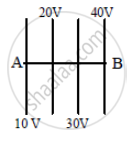 |
(ii)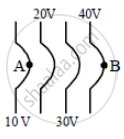 |
(iii)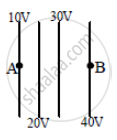 |
(iv)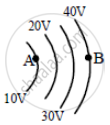 |
A positive charge is moved from A to B in each diagram.
Equipotential surfaces ______.
- are closer in regions of large electric fields compared to regions of lower electric fields.
- will be more crowded near sharp edges of a conductor.
- will be more crowded near regions of large charge densities.
- will always be equally spaced.
The direction in which electric potential decreases is:
In the derivation proving \[\vec{E}\] is perpendicular to an equipotential surface, a charge \[q_0\] undergoes a small displacement \[d\vec{l}\] along the surface, with \[\vec{E}\] making an angle \[\theta\] with the displacement. Equating the work expressions leads to which conclusion?
A particle floats between two parallel plates separated by 0.1 m with a potential difference of 4000 V. The particle carries a charge of \[1.6 \times 10^{-19}\] C. Taking \[g = 9.8\ \text{m/s}^2\], the mass of the particle is approximately:
