Advertisements
Advertisements
प्रश्न
The top of the atmosphere is at about 400 kV with respect to the surface of the earth, corresponding to an electric field that decreases with altitude. Near the surface of the earth, the field is about 100 Vm−1. Why then do we not get an electric shock as we step out of our house into the open? (Assume the house to be a steel cage so there is no field inside!)
Advertisements
उत्तर
We do not get an electric shock as we step out of our house because the original equipotential surfaces of open-air change, keeping our body and the ground at the same potential.
APPEARS IN
संबंधित प्रश्न
A man fixes outside his house one evening a two metre high insulating slab carrying on its top a large aluminium sheet of area 1 m2. Will he get an electric shock if he touches the metal sheet next morning?
The discharging current in the atmosphere due to the small conductivity of air is known to be 1800 A on an average over the globe. Why then does the atmosphere not discharge itself completely in due course and become electrically neutral? In other words, what keeps the atmosphere charged?
What is the geometrical shape of equipotential surfaces due to a single isolated charge?
Draw the equipotential surfaces due to an electric dipole. Locate the points where the potential due to the dipole is zero.
Depict the equipotential surfaces for a system of two identical positive point charges placed a distance(d) apart?
Define equipotential surface.
Write two important characteristics of equipotential surfaces.
S1 and S2 are the two imaginary surfaces enclosing the charges +q and -q as shown. The electric flux through S1 and S2 are respectively ______.
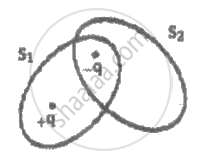
Consider the following statements and select the correct statement(s).
- Electric field lines are always perpendicular to equipotential surface.
- No two equipotential surfaces can intersect each other.
- Electric field lines are in the direction of tangent to an equipotential surface.
- The potential at all the points on an equipotential surface is same.
- Equipotential surfaces never intersect each other.
- Work done in moving a charge from one point to other on an equipotential surface is zero.
Equipotential surfaces ______.
Which of the following is NOT the property of equipotential surface?
The work done to move a charge along an equipotential from A to B ______.
- cannot be defined as `- int_A^B E.dl`
- must be defined as `- int_A^B E.dl`
- is zero.
- can have a non-zero value.
Draw equipotential surfaces for (i) an electric dipole and (ii) two identical positive charges placed near each other.
A curve connecting points that all have equal electric potential is best described as:
What is the shape of the equipotential surfaces for a single point charge (+q)?
For an electric dipole (+q, −q), the equipotential surfaces are best described as:
The relation between the electric field \[\vec{E}\] and the potential gradient is expressed as:
A particle floats between two parallel plates separated by 0.1 m with a potential difference of 4000 V. The particle carries a charge of \[1.6 \times 10^{-19}\] C. Taking \[g = 9.8\ \text{m/s}^2\], the mass of the particle is approximately:
