Advertisements
Advertisements
प्रश्न
Depict the equipotential surfaces for a system of two identical positive point charges placed a distance(d) apart?
Advertisements
उत्तर
An equipotential surface is a surface with a constant value of the potential at all points on the surface.
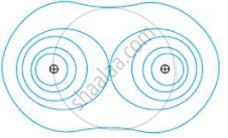
Equipotential surfaces for two identical positive charges.
APPEARS IN
संबंधित प्रश्न
A regular hexagon of side 10 cm has a charge 5 µC at each of its vertices. Calculate the potential at the centre of the hexagon.
The top of the atmosphere is at about 400 kV with respect to the surface of the earth, corresponding to an electric field that decreases with altitude. Near the surface of the earth, the field is about 100 Vm−1. Why then do we not get an electric shock as we step out of our house into the open? (Assume the house to be a steel cage so there is no field inside!)
Draw equipotential surfaces:
(1) in the case of a single point charge and
(2) in a constant electric field in Z-direction. Why are the equipotential surfaces about a single charge not equidistant?
(3) Can electric field exist tangential to an equipotential surface? Give reason
A particle of mass 'm' having charge 'q' is held at rest in uniform electric field of intensity 'E'. When it is released, the kinetic energy attained by it after covering a distance 'y' will be ______.
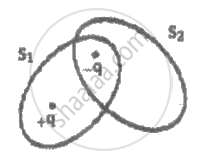
S1 and S2 are the two imaginary surfaces enclosing the charges +q and -q as shown. The electric flux through S1 and S2 are respectively ______.
The diagrams below show regions of equipotentials.
(i)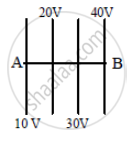 |
(ii)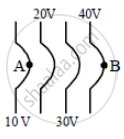 |
(iii)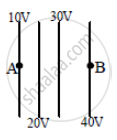 |
(iv)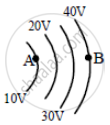 |
A positive charge is moved from A to B in each diagram.
Find the equation of the equipotentials for an infinite cylinder of radius r0, carrying charge of linear density λ.
Draw equipotential surfaces for (i) an electric dipole and (ii) two identical positive charges placed near each other.
In the derivation proving \[\vec{E}\] is perpendicular to an equipotential surface, a charge \[q_0\] undergoes a small displacement \[d\vec{l}\] along the surface, with \[\vec{E}\] making an angle \[\theta\] with the displacement. Equating the work expressions leads to which conclusion?
