Advertisements
Advertisements
प्रश्न
Prove that a closed equipotential surface with no charge within itself must enclose an equipotential volume.
Advertisements
उत्तर
Let us assume that in a closed equipotential surface with no charge the potential is changing from position to position. Let the potential just inside the surface is different to that of the surface causing a potential gradient (dV/dr)
It means E ≠ 0 electric field comes into existence, which is given by as E = – dV/dr
It means there will be field lines pointing inwards or outwards from the surface. These lines cannot be again on the surface, as the surface is equipotential. It is possible only when the other end of the field lines originated from the charges inside. This contradicts the original assumption. Hence, the entire volume inside must be equipotential.
APPEARS IN
संबंधित प्रश्न
Define an equipotential surface.
A regular hexagon of side 10 cm has a charge 5 µC at each of its vertices. Calculate the potential at the centre of the hexagon.
Two charges 2 μC and −2 µC are placed at points A and B 6 cm apart.
- Identify an equipotential surface of the system.
- What is the direction of the electric field at every point on this surface?
Describe schematically the equipotential surfaces corresponding to
(a) a constant electric field in the z-direction,
(b) a field that uniformly increases in magnitude but remains in a constant (say, z) direction,
(c) a single positive charge at the origin, and
(d) a uniform grid consisting of long equally spaced parallel charged wires in a plane.
The top of the atmosphere is at about 400 kV with respect to the surface of the earth, corresponding to an electric field that decreases with altitude. Near the surface of the earth, the field is about 100 Vm−1. Why then do we not get an electric shock as we step out of our house into the open? (Assume the house to be a steel cage so there is no field inside!)
A man fixes outside his house one evening a two metre high insulating slab carrying on its top a large aluminium sheet of area 1 m2. Will he get an electric shock if he touches the metal sheet next morning?
Why is there no work done in moving a charge from one point to another on an equipotential surface?
Two identical point charges, q each, are kept 2m apart in the air. A third point charge Q of unknown magnitude and sign is placed on the line joining the charges such that the system remains in equilibrium. Find the position and nature of Q.
A particle of mass 'm' having charge 'q' is held at rest in uniform electric field of intensity 'E'. When it is released, the kinetic energy attained by it after covering a distance 'y' will be ______.
Equipotentials at a great distance from a collection of charges whose total sum is not zero are approximately.
Equipotential surfaces ______.
Equipotential surfaces are shown in figure. Then the electric field strength will be ______.
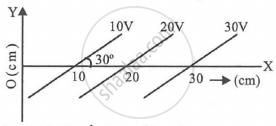
What is meant by an equipotential surface?
What is an equipotential surface?
A curve connecting points that all have equal electric potential is best described as:
If the electric field \[\vec{E}\] had a component along (tangent to) an equipotential surface, what contradiction would arise?
The direction in which electric potential decreases is:
The relation between the electric field \[\vec{E}\] and the potential gradient is expressed as:
