Advertisements
Advertisements
प्रश्न
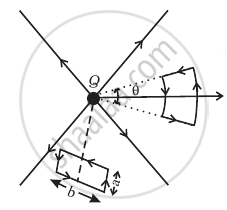
A test charge q is made to move in the electric field of a point charge Q along two different closed paths (Figure). First path has sections along and perpendicular to lines of electric field. Second path is a rectangular loop of the same area as the first loop. How does the work done compare in the two cases?
Advertisements
उत्तर
Work done will be zero in both cases.
Explanation: The electrostatic field is conservative, and in this field work done by electric force on the charge in a closed loop is zero. In this question both are closed paths, hence the work done in both cases will be zero.
APPEARS IN
संबंधित प्रश्न
A spherical conducting shell of inner radius r1 and outer radius r2 has a charge Q.
(a) A charge q is placed at the centre of the shell. What is the surface charge density on the inner and outer surfaces of the shell?
(b) Is the electric field inside a cavity (with no charge) zero, even if the shell is not spherical, but has any irregular shape? Explain.
A 4 µF capacitor is charged by a 200 V supply. It is then disconnected from the supply and is connected to another uncharged 2 µF capacitors. How much electrostatic energy of the first capacitor is lost in the form of heat and electromagnetic radiation?
If Coulomb’s law involved 1/r3 dependence (instead of 1/r2), would Gauss’s law be still true?
A 12 pF capacitor is connected to a 50 V battery. How much electrostatic energy is stored in the capacitor? If another capacitor of 6 pF is connected in series with it with the same battery connected across the combination, find the charge stored and potential difference across each capacitor.
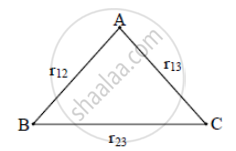
Define electrostatic potential at a point. Write its S.I. unit. Three-point charges q1, q2 and q3 are kept respectively at points A, B, and C as shown in the figure, Derive the expression for the electrostatic potential energy of the system.
Electric-field magnitude 'E' at points inside and outside a positively charged spherical conductor having charge Q and a radius R are ______.
The electrostatic potential on the surface of a charged conducting sphere is 100V. Two statements are made in this regard S1 at any point inside the sphere, electric intensity is zero. S2 at any point inside the sphere, the electrostatic potential is 100 V. Which of the following is a correct statement?
What happens to the electric field inside a conductor in electrostatic equilibrium?
Where does excess charge reside on a conductor in electrostatic equilibrium?
What is electrostatic shielding?
What does surface charge density represent, and what symbol denotes it?
Which expression gives the magnitude of the electric field on a charged conductor surface?
What does \(\varepsilon_0\) represent in the electric-field formula for a charged conductor surface?
How does an empty cavity inside a conductor relate to electrostatic shielding?
What did Faraday use to line a room in his demonstration?
What does Gauss's law give for a closed surface when the electric field inside the conductor is zero?
When a dry comb is run through dry hair, what transfers electrons and usually makes the comb negatively charged?
Why can a comb's attraction for paper be weak or absent on a rainy day or when the hair is wet?
Why are special aircraft tyres made slightly conducting?
