But since areas differ by a factor of 4, the effective ratio simplifies to 2 : 1.
Advertisements
Advertisements
प्रश्न
A point charge is placed at the centre of a hollow conducting sphere of internal radius ‘r’ and outer radius ‘2r’. The ratio of the surface charge density of the inner surface to that of the outer surface will be ______.
रिक्त स्थान भरें
Advertisements
उत्तर
A point charge is placed at the centre of a hollow conducting sphere of internal radius ‘r’ and outer radius ‘2r’. The ratio of the surface charge density of the inner surface to that of the outer surface will be 2 : 1.
Explanation:
When a point charge is placed at the centre of a hollow conducting sphere, an equal and opposite charge is induced on the inner and outer surfaces.
Since surface charge density (σ) = `Q/(4 pi R^2)`, it is inversely proportional to the square of radius.
Inner radius = r
Outer radius = 2r
`sigma_"inner" : sigma_"outer" = 1/r^2 : 1/((2 r)^2)`
= 4 : 1
shaalaa.com
क्या इस प्रश्न या उत्तर में कोई त्रुटि है?
संबंधित प्रश्न
A spherical conducting shell of inner radius r1 and outer radius r2 has a charge Q.
(a) A charge q is placed at the centre of the shell. What is the surface charge density on the inner and outer surfaces of the shell?
(b) Is the electric field inside a cavity (with no charge) zero, even if the shell is not spherical, but has any irregular shape? Explain.
A 4 µF capacitor is charged by a 200 V supply. It is then disconnected from the supply and is connected to another uncharged 2 µF capacitors. How much electrostatic energy of the first capacitor is lost in the form of heat and electromagnetic radiation?
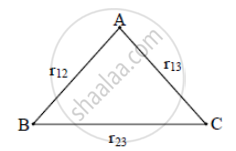
Define electrostatic potential at a point. Write its S.I. unit. Three-point charges q1, q2 and q3 are kept respectively at points A, B, and C as shown in the figure, Derive the expression for the electrostatic potential energy of the system.
If R is the radius of a spherical conductor, Vm the dielectric strength, then the maximum electric-field magnitude to which it can be raised is ______.
The electrostatic force between the metal plates of an isolated parallel plate capacitor C having a charge Q and area A, is ______.
Which of the following statements is false for a perfect conductor?
What happens to the electric field inside a conductor in electrostatic equilibrium?
What is an equipotential body?
The statement that the electric field inside a conductor is zero is true under which condition?
What did Faraday use to confirm that the room's interior remained charge-free?
