Advertisements
Advertisements
प्रश्न
A spherical conducting shell of inner radius r1 and outer radius r2 has a charge Q.
(a) A charge q is placed at the centre of the shell. What is the surface charge density on the inner and outer surfaces of the shell?
(b) Is the electric field inside a cavity (with no charge) zero, even if the shell is not spherical, but has any irregular shape? Explain.
Advertisements
उत्तर
Surface charge density at the inner surface of the shell is given by the relation,
`sigma_1 = "Total Charge"/"Inner surface area" = (-q)/(4pi"r"_2^2)` ..........(1)
A charge of +q is induced on the outer surface of the shell. A charge of magnitude Q is placed on the outer surface of the shell. Therefore, the total charge on the outer surface of the shell is Q + q. Surface charge density at the outer surface of the shell,
`sigma_2 = "Total Charge"/"Outersurface area" = ("Q" + "q")/(4pi"r"_2^2)` ..........(2)
(b) Yes
The electric field intensity inside a cavity is zero, even if the shell is not spherical and has any irregular shape. Take a closed loop such that a part of it is inside the cavity along a field line while the rest is inside the conductor. Net work done by the field in carrying a test charge over a closed loop is zero because the field inside the conductor is zero. Hence, the electric field is zero, whatever is the shape.
APPEARS IN
संबंधित प्रश्न
A spherical conductor of radius 12 cm has a charge of 1.6 × 10⁻⁷ C distributed uniformly on its surface. What is the electric field
- inside the sphere
- just outside the sphere
- at a point 18 cm from the centre of the sphere?
(a) Show that the normal component of electrostatic field has a discontinuity from one side of a charged surface to another given by
`(vec"E"_2 - vec"E"_1).hat"n" = sigma/in_0`
Where `hat"n"` is a unit vector normal to the surface at a point and σ is the surface charge density at that point. (The direction of `hat"n"` is from side 1 to side 2.) Hence show that just outside a conductor, the electric field is σ `hat"n"/in_0`
(b) Show that the tangential component of electrostatic field is continuous from one side of a charged surface to another.
[Hint: For (a), use Gauss’s law. For, (b) use the fact that work done by electrostatic field on a closed loop is zero.]
A 4 µF capacitor is charged by a 200 V supply. It is then disconnected from the supply and is connected to another uncharged 2 µF capacitors. How much electrostatic energy of the first capacitor is lost in the form of heat and electromagnetic radiation?
The electrostatic potential on the surface of a charged conducting sphere is 100V. Two statements are made in this regard S1 at any point inside the sphere, electric intensity is zero. S2 at any point inside the sphere, the electrostatic potential is 100 V. Which of the following is a correct statement?
The electrostatic force between the metal plates of an isolated parallel plate capacitor C having a charge Q and area A, is ______.
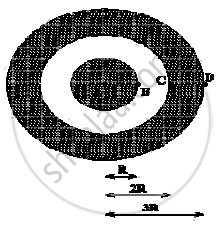
A solid spherical conductor has charge +Q and radius R. It is surrounded by a solid spherical shell with charge -Q, inner radius 2R, and outer radius 3R. Which of the following statements is true?
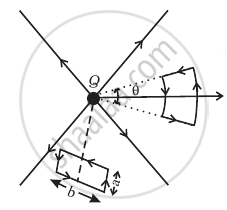
A test charge q is made to move in the electric field of a point charge Q along two different closed paths (Figure). First path has sections along and perpendicular to lines of electric field. Second path is a rectangular loop of the same area as the first loop. How does the work done compare in the two cases?
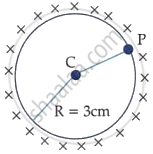
A thin spherical shell is charged by some source. The potential difference between the two points C and P (in V) shown in the figure is:
(Take `1/(4 pi epsilon_0` = 9 × 10⁹ SI units)
What is the direction of the electric field at the surface of a conductor in electrostatic equilibrium?
Which condition defines electrostatic equilibrium?
What does surface charge density represent, and what symbol denotes it?
Which expression gives the magnitude of the electric field on a charged conductor surface?
What does \(\varepsilon_0\) represent in the electric-field formula for a charged conductor surface?
Why is the potential constant throughout a conductor in electrostatic equilibrium?
For the Gaussian pillbox at a charged conductor's surface, from which face does the flux come?
What did Faraday use to line a room in his demonstration?
