Advertisements
Advertisements
प्रश्न
A 4 µF capacitor is charged by a 200 V supply. It is then disconnected from the supply and is connected to another uncharged 2 µF capacitors. How much electrostatic energy of the first capacitor is lost in the form of heat and electromagnetic radiation?
Advertisements
उत्तर
Capacitance of a charged capacitor, `"C"_1 = mu"F" = 4 xx 10^-6 "F"`
Supply voltage, V1 = 200 V
Electrostatic energy stored in C1 is given by,
`"E"_1 = 1/2"C"_1"V"_1^2`
= `1/2 xx 4 xx 10^-6 xx (200)^2`
= `8 xx 10^-2 "J"`
Capacitance of an uncharged capacitor, `"C"_2 = 2mu"F" = 2 xx 10^-6 "F"`
When C2 is connected to the circuit, the potential acquired by it is V2.
According to the conservation of charge, the initial charge on capacitor C1 is equal to the final charge on capacitors, C1 and C2.
∴ `"V"_2("C"_1 + "C"_2) = "C"_1"V"_1`
`"V"_2 xx (4 + 2) xx 10^-6 = 4 xx 10^-6 xx 200`
`"V"_2 = 400/3` V
Electrostatic energy for the combination of two capacitors is given by,
`"E"_2 = 1/2("C"_1 + "C"_2)"V"_2^2`
= `1/2(2 + 4)xx 10^-6 xx (400/3)^2`
= `5.33 xx 10^-2` J
Hence, amount of electrostatic energy lost by capacitor C1
= E1 − E2
= 0.08 − 0.0533
= 0.0267
= 2.67 × 10⁻² J
APPEARS IN
संबंधित प्रश्न
(a) Show that the normal component of electrostatic field has a discontinuity from one side of a charged surface to another given by
`(vec"E"_2 - vec"E"_1).hat"n" = sigma/in_0`
Where `hat"n"` is a unit vector normal to the surface at a point and σ is the surface charge density at that point. (The direction of `hat"n"` is from side 1 to side 2.) Hence show that just outside a conductor, the electric field is σ `hat"n"/in_0`
(b) Show that the tangential component of electrostatic field is continuous from one side of a charged surface to another.
[Hint: For (a), use Gauss’s law. For, (b) use the fact that work done by electrostatic field on a closed loop is zero.]
A 12 pF capacitor is connected to a 50 V battery. How much electrostatic energy is stored in the capacitor? If another capacitor of 6 pF is connected in series with it with the same battery connected across the combination, find the charge stored and potential difference across each capacitor.
A point charge is placed at the centre of a hollow conducting sphere of internal radius ‘r’ and outer radius ‘2r’. The ratio of the surface charge density of the inner surface to that of the outer surface will be ______.
Which of the following statement is true?
Which of the following statements is false for a perfect conductor?
Three Charges 2q, -q and -q lie at vertices of a triangle. The value of E and V at centroid of triangle will be ______.
A solid spherical conductor has charge +Q and radius R. It is surrounded by a solid spherical shell with charge -Q, inner radius 2R, and outer radius 3R. Which of the following statements is true?
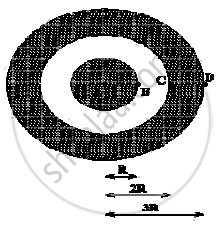
Consider a finite insulated, uncharged conductor placed near a finite positively charged conductor. The uncharged body must have a potential:
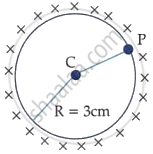
A thin spherical shell is charged by some source. The potential difference between the two points C and P (in V) shown in the figure is:
(Take `1/(4 pi epsilon_0` = 9 × 10⁹ SI units)
Which expression gives the electric field on a charged conductor surface in vector form?
In the surface-field expression \[\vec{E}=\frac{\sigma}{\varepsilon_0}\hat{n}\], what does \(\hat{n}\) represent?
The statement that the electric field inside a conductor is zero is true under which condition?
What would a tangential component of the electric field at a conductor's surface cause?
In the mini derivation of the charged conductor's surface field, what is used with Gauss's law?
What did Faraday use to line a room in his demonstration?
Why can a comb's attraction for paper be weak or absent on a rainy day or when the hair is wet?
Why are special aircraft tyres made slightly conducting?
