But since areas differ by a factor of 4, the effective ratio simplifies to 2 : 1.
Advertisements
Advertisements
प्रश्न
A point charge is placed at the centre of a hollow conducting sphere of internal radius ‘r’ and outer radius ‘2r’. The ratio of the surface charge density of the inner surface to that of the outer surface will be ______.
रिकाम्या जागा भरा
Advertisements
उत्तर
A point charge is placed at the centre of a hollow conducting sphere of internal radius ‘r’ and outer radius ‘2r’. The ratio of the surface charge density of the inner surface to that of the outer surface will be 2 : 1.
Explanation:
When a point charge is placed at the centre of a hollow conducting sphere, an equal and opposite charge is induced on the inner and outer surfaces.
Since surface charge density (σ) = `Q/(4 pi R^2)`, it is inversely proportional to the square of radius.
Inner radius = r
Outer radius = 2r
`sigma_"inner" : sigma_"outer" = 1/r^2 : 1/((2 r)^2)`
= 4 : 1
shaalaa.com
या प्रश्नात किंवा उत्तरात काही त्रुटी आहे का?
संबंधित प्रश्न
If Coulomb’s law involved 1/r3 dependence (instead of 1/r2), would Gauss’s law be still true?
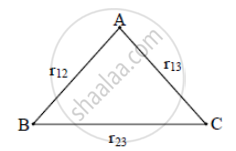
Define electrostatic potential at a point. Write its S.I. unit. Three-point charges q1, q2 and q3 are kept respectively at points A, B, and C as shown in the figure, Derive the expression for the electrostatic potential energy of the system.
Electric-field magnitude 'E' at points inside and outside a positively charged spherical conductor having charge Q and a radius R are ______.
The electrostatic potential on the surface of a charged conducting sphere is 100V. Two statements are made in this regard S1 at any point inside the sphere, electric intensity is zero. S2 at any point inside the sphere, the electrostatic potential is 100 V. Which of the following is a correct statement?
Consider a finite insulated, uncharged conductor placed near a finite positively charged conductor. The uncharged body must have a potential:
What is electrostatic shielding?
How does an empty cavity inside a conductor relate to electrostatic shielding?
In the mini derivation of the charged conductor's surface field, what is used with Gauss's law?
Which justification is used for the formula \[E=\frac{\sigma}{\varepsilon_0}\]?
What did Faraday use to confirm that the room's interior remained charge-free?
