Advertisements
Advertisements
प्रश्न
Can the potential function have a maximum or minimum in free space?
Advertisements
उत्तर
No, the potential function does not have a maximum or minimum in free space, it is because the absence of atmosphere around the conductor prevents the phenomenon of electric discharge or potential leakage.
APPEARS IN
संबंधित प्रश्न
When an AC source is connected to an ideal capacitor, show that the average power supplied by the source over a complete cycle is zero
A capacitor of capacitance C is charged fully by connecting it to a battery of emf E. It is then disconnected from the battery. If the separation between the plates of the capacitor is now doubled, how will the following change?
(i) charge stored by the capacitor.
(ii) Field strength between the plates.
(iii) Energy stored by the capacitor.
Justify your answer in each case.
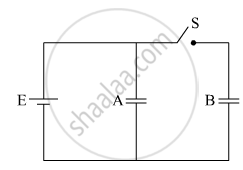
Two identical parallel plate capacitors A and B are connected to a battery of V volts with the switch S closed. The switch is now opened and the free space between the plates of the capacitors is filled with a dielectric of dielectric constant K. Find the ratio of the total electrostatic energy stored in both capacitors before and after the introduction of the dielectric.
A capacitor has capacitance C. Is this information sufficient to know what maximum charge the capacitor can contain? If yes, what is this charges? If no, what other information is needed?
The two square faces of a rectangular dielectric slab (dielectric constant 4⋅0) of dimensions 20 cm × 20 cm × 1⋅0 mm are metal-coated. Find the capacitance between the coated surfaces.
A parallel-plate capacitor of plate area A and plate separation d is charged to a potential difference V and then the battery is disconnected. A slab of dielectric constant K is then inserted between the plates of the capacitor so as to fill the space between the plates. Find the work done on the system in the process of inserting the slab.
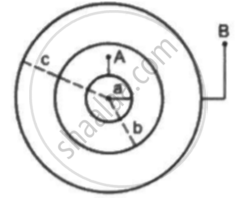
Consider an assembly of three conducting concentric spherical shell of radii a, b and c as shown in figure Find the capacitance of the assembly between the points Aand B.
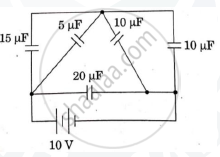
The figure show a network of five capacitors connected to a 10V battery. Calculate the charge acquired by the 5μF capacitor.
You are provided with 8 μF capacitors. Show with the help of a diagram how you will arrange minimum number of them to get a resultant capacitance of 20 μF.
Obtain an expression for equivalent capacitance when three capacitors C1, C2 and C3 are connected in series.
If the voltage applied on a capacitor is increased from V to 2V, choose the correct conclusion.
Three capacitors 2µF, 3µF, and 6µF are joined in series with each other. The equivalent capacitance is ____________.
A capacitor of capacity 2 µF is charged to a potential difference of 12 V. It is then connected across an inductor of inductance 0.6 mH. The current in the circuit at a time when the potential difference across the capacitor is 6.0 V is ______ × 10-1A.
Eight drops of mercury of equal radius and possessing equal charge combine to form a big drop. The capacitance of bigger drop as compared to each small drop is ______.
Two spherical conductors of capacities 4 µF and 3 µF are charged to same potential having radii 4 cm and 3 cm respectively. If ‘σ1’ and ‘σ2’ represent surface density of charge on respective conductors then ______.
Which system is called a capacitor?
What is called the capacity of conductor?
